
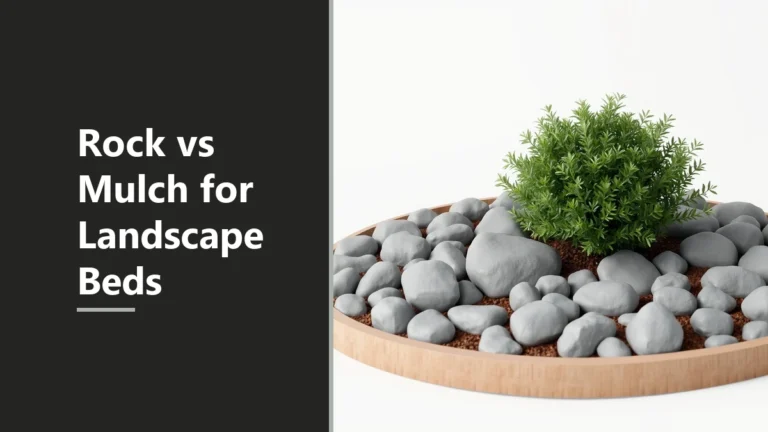
Does rock keep a landscape bed cooler than mulch? Extension sources disagree on the reason, and each one is a state extension publication from Nevada, Arizona, Washington, Colorado or Texas.
Rock is called permanent, but UNR says it degrades and needs refreshing, and it does not improve soil. Organic mulch breaks down, enriches soil and needs replacing after several years. Sources say rock runs hotter in the sun but disagree on why. Local rules, permits and your supplier decide what suits your site.
Rock vs Mulch for Landscape Beds: The Core Differences
Arizona Cooperative Extension describes inorganic mulches as non-living materials that are slow to decompose, and it names gravel among them. Organic mulches break down over time, as CSU and Texas A&M both describe. The two types overlap in some jobs and split on others.
They share some jobs. UNR says organic and inorganic mulches both limit evaporation from the soil. WSU lists conserving water, suppressing weeds and evening out soil temperature extremes as the main benefits of most mulch applications.
They split on soil. UNR says inorganic mulches do not improve soil conditions, while Texas A&M says organic mulches enrich soil as they decay. WSU adds that organic mulch can add nutrients.
To size a rock bed before you buy, use the Landscape Rock Calculator for tons, cubic yards and coverage per ton.
Does Rock Make a Bed Hotter Than Mulch?
Yes, in the sun. CSU PlantTalk 1609 says organic mulches are cooler than rock mulches in the sun, and UNR says organic mulch gives cooler soils. The sources disagree on the mechanism, though.
UNR Special Publication 06-10 (2006) says rock absorbs heat, and it adds that “rock mulches raise the temperature of both the soil and the surrounding air.”
CSU says rock absorbs and stores heat for long periods, then reradiates it to plants. Arizona Cooperative Extension says rock or gravel collects heat and raises temperatures, which can increase cooling costs for the home and irrigation costs for the landscape in summer.
WSU C075, revised in 2023, describes the mechanism differently. It says most rocks reflect solar radiation and can cause a very hot landscape environment during the summer months.
Texas A&M E-512 covers mulch color, not rock. It advises light-colored mulch in summer to reflect heat and dark mulch in early spring to warm soil. That guidance is written for vegetable gardens, so it does not settle the color question for rock.
How Well Do Rock and Mulch Control Weeds?
All mulches have a weed-blocking role, according to UNR, whether organic, inorganic or living. Rock has a catch, though. UNR says weeds that emerge between rocks may be difficult to remove.
Fabric under rock is the common question, and the sources split on it: UNR advises landscape fabric, not sheet plastic, and says a two-inch layer of rock over fabric is sufficient, while Arizona says weeds still establish even with fabric underneath.
Arizona explains that weed seeds are easily blown into gravel or stone and soon establish themselves. WSU, discussing fabric in general, says weeds germinate on top of it and root into or through it.
Upkeep matters too. UNR says rock mulches become unsightly when trash gets caught in them.
None of the five sources gives a weed count or a percent reduction, so do not expect a number from them. Read the weed advice as a direction, not a measurement.
How Organic Mulch Affects Soil and Moisture
Organic mulch breaks down, and that breakdown is where its soil benefit comes from. Texas A&M says organic mulches enrich soil as they decay and improve the environment for plant growth. WSU adds that organic mulch can add nutrients.
The trade-off is replacement. CSU says organic mulch breaks down and needs replacing after several years. No source gives a breakdown rate in years, so inspect the bed rather than count on a set date.
Rock is slow to decompose, according to Arizona, but UNR says rock degrades over time and needs refreshing.
On moisture, the sources speak in general terms. UNR says organic and inorganic mulches limit evaporation from the soil, and CSU says rock can also hold in moisture. No source gives a moisture percentage, so this article cannot rank the two on water savings.
Which Plants Suit Rock or Organic Mulch?
The answer depends on the plants, according to UNR. For non-desert plants, UNR says inorganic mulches would not benefit them much. Organic mulch is more appropriate, because it keeps soils cooler and breaks down slowly to nourish developing plants.
For desert plants, UNR says the organic advice does not hold. Desert plants would probably not benefit much from organic mulches, which can keep soil temperatures lower.
WSU describes rock as a permanent installation best used around foundation plants. That is a placement note, not a finding about plant health.
Plant health is where the sources are weakest. They make general statements about plant benefit and report no measured plant results for either mulch type.
How Much Rock Does a Bed Need?
Multiply the bed area by the depth, divide by 324 for cubic yards, then multiply by the rock density. The 324 is 12 inches per foot times 27 cubic feet per cubic yard.
The densities come from the tool’s settings, not from an extension publication. We could not trace the river rock figure of 1.4 tons per cubic yard to any source we read, so treat every density as a tool setting.
Take a 200 square foot bed at 2 inches of river rock. The volume is 200 x 2 / 324, or 1.23 cubic yards. At 1.4 tons per cubic yard, that is 1.73 tons before overage. Add the default 10 percent overage and the order is 1.90 tons.
The tool’s intro says this bed needs about 1.7 tons, which matches the figure before overage. The 1.90 in the result panel includes the overage. Coverage at that depth is about 116 square feet per ton, from 324 / (1.4 x 2).
| Bed | Volume (cubic yards) | Tons before overage | Tons with 10 percent overage | Coverage per ton |
|---|---|---|---|---|
| 200 sq ft, 2 in, river rock (1.4) | 1.23 | 1.73 | 1.90 | About 116 sq ft |
| 150 sq ft, 3 in, lava rock (0.6) | 1.39 | 0.83 | 0.92 | About 180 sq ft |
The figures come from unrounded numbers, so multiplying the rounded values on screen can differ by 0.01 ton.
Depth raises the tonnage quickly. The same 200 square foot bed at 4 inches needs 3.46 tons before overage, and each ton covers about 58 square feet.
The tool has no organic mulch setting, and these sources give no mulch density, so the method cannot produce a ton figure for mulch. The volume step still works. The same 200 square foot bed at 2 inches is 1.23 cubic yards of material.
What the Sources Do Not Tell You About Cost and Climate
The five sources give no price for rock or mulch. We found no dated cost per ton or per cubic yard in them, so this article offers no cost comparison. The calculator also leaves out fabric, edging, delivery, labor and pricing.
The sources give no temperature difference in degrees and no moisture percentage. All five are state extension publications, so their advice reflects their own regions. They do not settle how rock affects soil temperature in humid or cold climates, and that question remains unverified here.
Local rules, permits and your supplier or engineer decide what suits your site.
Enter your bed area, depth and rock type in the rock tonnage and coverage tool. It returns tons to order, cubic yards and coverage per ton, but no prices.
FAQs About Rock vs Mulch
Is rock or organic mulch better for a landscape bed?
Neither wins on every point. Organic mulch breaks down and enriches soil, and UNR says it suits non-desert plants. Rock is called permanent, but UNR says it degrades and needs refreshing.
Does rock make a garden bed hotter than mulch?
In the sun, CSU says yes, because organic mulches are cooler than rock. Sources differ on the cause. UNR and CSU say rock absorbs heat, while WSU says rock reflects it.
Does rock mulch stop weeds?
Not on its own. Arizona says weed seeds blow into gravel and establish, even over landscape fabric. UNR says weeds between rocks can be hard to remove.
How much rock do I need for a 200 square foot bed at 2 inches?
At the tool’s river rock setting of 1.4 tons per cubic yard, the bed needs 1.73 tons before overage and 1.90 tons with 10 percent overage. The density is a tool setting, not verified.
How long does organic mulch last?
CSU says organic mulch breaks down and needs replacing after several years. None of the five sources gives a breakdown rate in years, so check the bed rather than follow a set schedule.
Is rock mulch good for every plant?
No. UNR says non-desert plants would not benefit much from inorganic mulches, and desert plants would probably not benefit much from organic mulch. The sources make general statements and measure no plant health results.
Does the rock calculator include fabric or delivery costs?
No. The calculator returns tons, cubic yards and coverage per ton. It leaves out fabric, edging, delivery, labor and pricing, so add those costs separately with your supplier.
Sources and Further Reading
References Used in This Article
- University of Nevada, Reno Extension, Special Publication SP 06-10, “Mulches for Nevada Landscapes” (O’Callaghan, 2006), accessed 2026-11-15.
- Colorado State University Extension, PlantTalk Colorado 1609, “Organic Mulches” (date not verified), accessed 2026-11-15.
- Washington State University Extension, C075, “Guide to Mulches” (revised 2023), accessed 2026-11-15.
- Texas A&M AgriLife Extension, E-512, “Mulching” (date not verified), accessed 2026-11-15.
- Arizona Cooperative Extension, “Mulches” (date not verified), accessed 2026-11-15.
Sources disagree on how rock heats a bed, so each view above is attributed to its source. This article gives no prices, and local rules, permits and your engineer or supplier decide the final choice. Reviewed for accuracy by Prof. Dr. Khalil Mudassar, PhD. Last updated 2026-11-15.

Shakeel Muzaffar is the Founder and Editor-in-Chief, with over 15 years of experience in digital publishing and online tool development. He oversees editorial quality and formula verification to ensure accurate, practical, and easy-to-use calculators.