
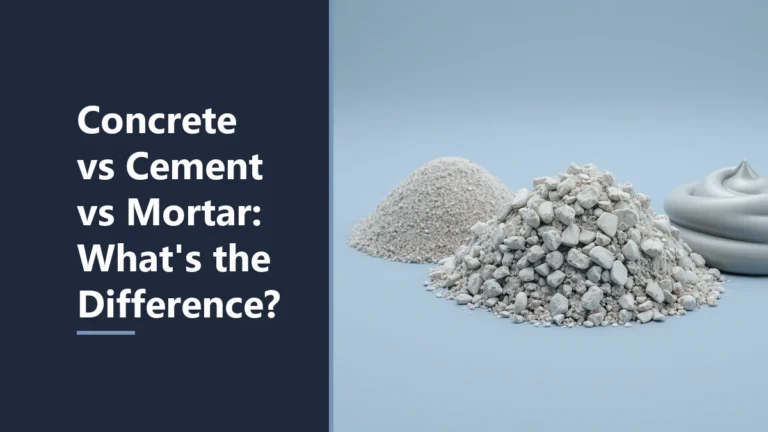
Walk down the hardware aisle and you will see bags labeled cement, concrete and mortar sitting side by side. They are not three names for one product. One is an ingredient, and the other two are finished mixes that use it.
Cement is not concrete, and concrete is not mortar. Cement is a fine binder powder. Mix it with water, sand and gravel and you get concrete, a structural material for slabs and footings. Mix cement with sand and no gravel and you get mortar, the bonding agent that holds brick and block together.
What Cement Is: The Powder That Binds
Cement is the binder, a fine gray powder that is an ingredient of concrete, not the finished material. The trade body cement.org calls it “a key ingredient of concrete” and the main ingredient in a concrete mix.
Cement is made by heating raw materials such as limestone and clay to a rock-like substance, then grinding that clinker with gypsum into a fine powder. Portland cement and portland-limestone cement are the most common types used in concrete. All portland and blended cements are hydraulic, which means they set and harden by reacting with water, and can do so even under water. On its own, cement does little. It needs water to react and aggregate to bind before it becomes something you can build with.
What Concrete Is and the Jobs It Handles
Concrete is a hardened, rock-like mix of cement paste and aggregate, and it works as a structural material on its own. A paste of cement and water coats the aggregate, which is sand, gravel or crushed stone.
As the cement reacts with the water, it binds the aggregate into a solid mass that keeps gaining strength for weeks after the pour. QUIKRETE Concrete Mix No. 1101 is designed for pouring concrete 2 inches thick or more, such as footings, sidewalks, steps, slabs and post footings. Its data sheet lists a 28-day compressive strength of 4000 psi. The same sheet says to protect fresh concrete from freezing during the first 48 hours.
To size a pour, our concrete mix calculator turns a volume and a nominal ratio into cement, sand and gravel quantities. It sizes concrete proportions only, not mortar. For the liquid side of a bagged pour, see our guide on how much water per bag.
What Mortar Is and the Jobs It Handles
Mortar is the bonding agent that holds brick, block and stone together in a masonry wall, and it is not a structural element by itself. The Brick Industry Association calls mortar “the bonding agent that integrates brick into a masonry assembly.”
Mortar uses a binder and fine sand, with no coarse gravel. QUIKRETE Mortar Mix No. 1102 is a pre-blended, sanded mortar for laying brick, concrete block and stone, and it meets ASTM C270 as Type N. Its yield is measured in units laid, not cubic feet. One 80 lb bag lays up to 37 standard bricks or 13 standard blocks. Mortar is usually specified to conform to ASTM C270, the standard for mortar used in unit masonry.
Cement, Concrete and Mortar Side by Side
The quickest way to keep the three straight is to compare what each one is, what goes into it, and the job it does. Cement is the ingredient, while concrete and mortar are mixes that use it for very different purposes.
| Material | What it is | Main ingredients | Typical use | A QUIKRETE product |
|---|---|---|---|---|
| Cement | A fine binder powder, an ingredient | Heated, ground limestone and clay (clinker plus gypsum) | Mixed into concrete or mortar; not used alone | Portland Cement No. 1124 |
| Concrete | A hardened structural mix | Cement paste (cement and water) plus sand and gravel | Slabs, footings, steps and walkways 2 in thick or more | Concrete Mix No. 1101 |
| Mortar | A bonding agent for masonry | Cement or masonry cement plus fine sand, no gravel | Laying brick, concrete block and stone | Mortar Mix No. 1102 (Type N) |
Read the table as one ingredient and two finished mixes. The coarse gravel in concrete gives it bulk and structural strength, while the fine sand in mortar lets it spread and bond between units.
Cement Types and a Portland Cement Example
Portland cements are made to ASTM C150, which defines several types for different conditions, such as Type I, Type II, Type III and Type V. There is no single cement for every job.
General-purpose cement, usually Type I or the widely available Type I/II, suits pavements, floors and buildings. Type III gives high early strength, and sulfate-resistant types serve soils with sulfate. QUIKRETE Portland Cement No. 1124 is sold as cement only. You add sand and gravel for concrete, or sand and lime for mortar. Its sheet does not name a specific ASTM type; it states the cement meets ASTM C150 or ASTM C595.
Here is the arithmetic the 1124 sheet supports. A 1:2:3 concrete by volume means 1 part cement, 2 parts sand and 3 parts gravel, which is 1 + 2 + 3 = 6 parts in all. That sum is simple arithmetic. The sheet states that five to six 94 lb bags of portland cement, with the right sand and gravel, make about 1 cubic yard of concrete. That is the sheet’s figure, not a full mix design.
Which Bag to Buy, and Why Not to Swap Them
Match the bag to the job: concrete mix for anything structural 2 inches thick or more, and mortar for laying masonry units. The label tells you which is which.
- A slab, footing, step or patio. Use a concrete mix such as QUIKRETE Concrete Mix No. 1101.
- A brick or block wall, or repointing joints. Use a mortar such as QUIKRETE Mortar Mix No. 1102, a Type N mortar.
- Mixing your own from scratch. Use portland cement such as No. 1124 with sand and gravel for concrete, or with sand and lime for mortar.
They are not interchangeable. The Brick Industry Association notes that because concrete and mortar share the same principal ingredients, people wrongly assume good concrete practice is good mortar practice. In reality the two differ in consistency and role, and concrete is usually a structural element in itself. Each data sheet also limits its product: the concrete mix is for pours 2 inches thick or more, and the mortar mix is for laying brick, block and stone.
Use the concrete mix calculator to size the cement, sand, gravel and bags for your pour, then browse the full set of concrete volume and ordering calculators.
FAQs About Concrete, Cement and Mortar
Is cement the same as concrete?
No. Cement is a fine binder powder and an ingredient. Concrete is the finished material you get when cement paste binds sand and gravel into a hard, rock-like mass. Cement is one part of concrete.
Can you use mortar instead of concrete, or concrete instead of mortar?
No, they are made for different jobs. Concrete has coarse gravel and acts as a structural material. Mortar has only fine sand and bonds masonry units. Each product’s data sheet limits it to its own use.
What is mortar made of?
Mortar is made from a binder and fine sand, with no coarse gravel. QUIKRETE Mortar Mix No. 1102 is a pre-blended, sanded mortar of masonry cement and graded sand that meets ASTM C270 as Type N.
What are the cement types?
Portland cements are made to ASTM C150, which defines several types such as Type I for general use, Type III for high early strength, and Type V for high sulfate resistance. Type I or Type I/II is the most widely available.
Is portland cement a type of concrete?
No. Portland cement is cement, the binder powder, not concrete. You make concrete by mixing portland cement with water, sand and gravel. Sold alone, as in QUIKRETE Portland Cement No. 1124, it is an ingredient.
What holds bricks together in a wall?
Mortar holds bricks together. The Brick Industry Association describes mortar as the bonding agent that integrates brick into a masonry assembly. It must bond the units and help create a water-resistant barrier.
Which QUIKRETE product do I buy for a slab versus a block wall?
For a slab, use QUIKRETE Concrete Mix No. 1101, made for pours 2 inches thick or more. For a block wall, use QUIKRETE Mortar Mix No. 1102, a Type N mortar for laying masonry units.
Sources and Further Reading
References Used in This Article
- cement.org, Cement and Concrete FAQ, “What is the difference between cement and concrete?”, accessed 2026-10-20.
- Brick Industry Association, Technical Note 8, Mortars for Brickwork (March 2020), accessed 2026-10-20.
- QUIKRETE, Concrete Mix No. 1101 data sheet (Revised October 2022), accessed 2026-10-20.
- QUIKRETE, Mortar Mix No. 1102 data sheet (Revised November 2020), accessed 2026-10-20.
- QUIKRETE, Portland Cement No. 1124 data sheet (Revised August 2022), accessed 2026-10-20.
Cement, concrete and mortar are not interchangeable, so match the product to the job and read the bag. The product details here come from manufacturer data sheets and industry references, which can change between editions. Reviewed for accuracy by Prof. Dr. Khalil Mudassar, PhD. Last updated 2026-10-20.

Shakeel Muzaffar is the Founder and Editor-in-Chief, with over 15 years of experience in digital publishing and online tool development. He oversees editorial quality and formula verification to ensure accurate, practical, and easy-to-use calculators.