
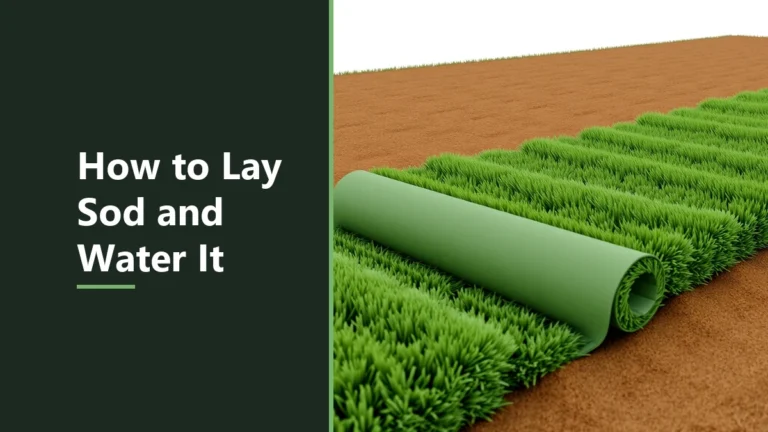
How do you turn a pallet of cut grass into a lawn that roots in two or three weeks? Start with one fact from the University of Maryland Extension: sod carries only about 1 inch of roots and soil, so it is highly perishable. The work before, during and after laying decides how well it takes.
To lay sod, grade and loosen the soil, then moisten it lightly. Lay pieces along a straight edge with tight, staggered seams like brickwork, running across any slope. Water right away, then keep the soil moist for 2 to 3 weeks until roots grab, per UMD, Mississippi State, UF/IFAS and Colorado State.
What Should You Do to the Soil Before Sod Arrives?
Test the soil and grade it so water drains away from buildings. Then work in organic matter where it is needed, rake the bed smooth and moisten it. The four extension guides agree on that order. They differ on depths, amounts and the pH that calls for lime.
| Source | Depth to work amendments | Organic matter | Lime trigger |
|---|---|---|---|
| UMD (Maryland) | Top 4 to 6 in; do not till wet soil | 1 to 2 in of compost (about 3 or 6 cu yd per 1,000 sq ft) when organic matter is under 3 percent | pH below 5.5; best range 6.0 to 6.8 |
| Mississippi State (Midsouth) | Top 6 to 10 in | Compost at 25 to 50 percent by volume | pH below 6 |
| Colorado State | Top 6 to 8 in; cultivate compacted soil 12 in deep | 3 to 5 cu yd of compost, manure or peat per 1,000 sq ft | No pH figure cited here |
For grading, UMD suggests a 1 to 2 percent slope away from buildings, which it puts at roughly 1.25 to 2.5 in of drop per 10 ft. Mississippi State University Extension (MSU) adds a simple rule: no low spots where water can sit. MSU says to take soil test cores 3 to 5 in deep.
UMD finishes the bed with light raking or a light pass with a roller. Colorado State plans moisture further ahead. It says to moisten the soil 6 to 8 in deep several days before delivery, so it is slightly moist, not wet, on laying day.
How Much Sod Should You Order for Your Lawn?
Measure the lawn in square feet, then add a small margin: MSU says to order about 5 percent more sod than you measure. MSU works in square yards and pallets and UMD in rolls, so convert to whichever unit your quote uses. Here is a 1,000 sq ft lawn worked by hand.
- Add MSU’s 5 percent. 1,000 x 1.05 = 1,050 sq ft to order.
- Convert to square yards. MSU notes that one square yard is 9 sq ft, so 1,050 / 9 = 116.7 sq yd.
- Count pallets. MSU says a pallet typically holds 450 to 500 sq ft. At 450, 1,050 / 450 = 2.33, so you need 3 pallets. At 500, 1,050 / 500 = 2.1, still 3 pallets.
- Count pieces. UMD says a standard roll covers about 10 sq ft, so 1,050 / 10 = 105 rolls.
The Sod Calculator runs the same math with its own settings. Its default overage is 10 percent, which is a tool setting, not a figure from these guides. At that setting, 1,000 sq ft becomes 1,100 sq ft, or 3 pallets of 450 (1,100 / 450 = 2.44). With its 2.66 sq ft slab, 1,100 / 2.66 = 413.5, which rounds up to 414 slabs. Slab and roll sizes vary by supplier, so check the size on your quote and set the overage to 5 percent to match MSU.
When Can You Lay Sod, and How Long Can It Wait?
You can lay sod any time the ground is not frozen and daytime temperatures stay below 90 F, according to UMD. Colorado State frames it by season: any time in the growing season, as long as the sod roots before fall freezes.
Delivery day sets a short clock. UF/IFAS says to lay sod within 24 hours of delivery. When it must wait a couple of days, UMD says to unstack the pieces and lay them flat, grass side up, in shade.
Plan for weight, too, because the two guides that give a figure disagree. MSU says a 450 sq ft pallet can weigh as much as a ton, or about 4.4 lb per sq ft. UMD says a 10 sq ft roll weighs 20 to 40 lb, or 2 to 4 lb per sq ft, depending on moisture and thickness. For the 1,050 sq ft order above, UMD’s range gives 105 x 20 = 2,100 lb to 105 x 40 = 4,200 lb. MSU’s rate gives up to about 4,670 lb. MSU also warns that big rolls need special equipment.
How to Lay Sod Step by Step
Lay sod on lightly moistened soil, starting along a straight edge. Butt each piece tight to the next and stagger the seams like brickwork. That method comes from UMD, and UF/IFAS and MSU describe the same staggered fit. The details below fill in the rest.
- Wet the bed first. UMD says to lightly moisten the site. UF/IFAS says to lightly irrigate the soil just before laying.
- Start straight. Begin the first row along a straight edge (UMD).
- Butt, do not overlap. Push each edge against the last piece without overlapping it (UMD). UF/IFAS says to fit pieces tightly.
- Stagger the ends. Offset the seams in each row, and avoid straight seams running downhill (MSU).
- Work across slopes. On a slope, lay the rows across it and pin the pieces in place (UMD).
- Protect your work. Walk on a plank or a sheet of plywood while you lay, then roll the finished lawn lightly (UMD).
How Often Should You Water New Sod?
Water new sod immediately after laying, then keep it moist with frequent watering, possibly daily, for the first 2 to 3 weeks. After roots form, water less often but more deeply. All four guides follow that arc, but they slice the weeks differently.
MSU gives the most detail. In week 1, the soil should feel soft underfoot but not oozing, and MSU suggests a screwdriver test to check. Sod tacks down within about a week in peak growing conditions. After that, MSU says water daily, then every other day after 2 to 3 weeks. In summer heat, more than once a day may be needed. MSU calls hand watering best for the first soak and suggests tuna cans to check how much a sprinkler puts down.
UMD says to water regularly, possibly daily, for 2 to 3 weeks, then less often but longer. It works up to about 1 in per session to keep the top 4 to 6 in moist, and it advises against evening watering. UF/IFAS calls for light, frequent watering for 2 to 3 weeks, moist but not soggy, then tapering. Colorado State says the same: moist, not soggy, until the sod roots, then less often and more deeply.
When Can You Walk On, Mow and Feed New Sod?
Stay off new sod until it roots, which UMD and Colorado State say usually takes 2 to 3 weeks. To check, lift a corner or give a piece a gentle tug. Neither guide sets a fixed date, so let the tug test decide.
For mowing, UF/IFAS gives the only timeline among these guides. “Wait three to four weeks before you mow,” it advises. MSU adds that mowing is rarely needed right after laying, and that soft soil may rut. UMD says a full lawn typically establishes 3 to 4 weeks after laying, which lines up with the UF/IFAS window.
Feeding waits longer. UF/IFAS says to wait 30 to 60 days before fertilizing new sod. Until then, the main job is steady moisture.
Enter your measured area in the sod calculator for pallets and pieces. Set the overage to 5 percent to match Mississippi State, and confirm the slab or roll size with your supplier.
FAQs About Laying and Watering Sod
Should you water the soil before laying sod?
Yes. UMD says to lightly moisten the site, and UF/IFAS says to lightly irrigate just before laying. Colorado State says to moisten the soil 6 to 8 inches deep several days ahead, slightly moist but not wet.
Can you water new sod at night?
The University of Maryland Extension advises against evening watering for new sod. Plan watering for earlier in the day, and keep the soil moist but not soggy during the first 2 to 3 weeks.
How do you know if new sod has rooted?
Lift a corner or give a piece a gentle tug. UMD and Colorado State say roots usually form within 2 to 3 weeks. Sod that holds firm has started to root into the soil below.
Should sod pieces overlap at the seams?
No. UMD says to butt pieces tightly without overlapping and to stagger the seams like brickwork. Mississippi State adds that seams should never run in a straight line downhill.
How long can sod sit on the pallet before you lay it?
UF/IFAS says to lay sod within 24 hours of delivery. When it must wait a couple of days, UMD says to unstack the pieces and lay them flat, grass side up, in shade.
Is it too hot to lay sod in summer?
Not always. UMD says sod can go down any time the ground is not frozen and daytime temperatures stay below 90 F. In summer heat, Mississippi State says new sod may need water more than once a day.
When can you fertilize new sod?
UF/IFAS says to wait 30 to 60 days after laying before you fertilize new sod. The same guide says to hold off on the first mow for three to four weeks.
Sources and Further Reading
References Used in This Article
- University of Maryland Extension, Starting a New Lawn (updated March 16, 2026), accessed 2026-11-15.
- Mississippi State University Extension, Publication 2951, Sod Installation and Maintenance, accessed 2026-11-15.
- UF/IFAS Gardening Solutions, Planting Your Florida Lawn, accessed 2026-11-15.
- Colorado State University Extension, PlantTalk Colorado 1517, Sodding a Lawn, accessed 2026-11-15.
These steps come from four university extension guides written for Maryland, the Midsouth, Florida and Colorado. Timing and amounts vary by region, so check with your local extension office. Reviewed for accuracy by Prof. Dr. Khalil Mudassar, PhD. Last updated 2026-11-15.

Shakeel Muzaffar is the Founder and Editor-in-Chief, with over 15 years of experience in digital publishing and online tool development. He oversees editorial quality and formula verification to ensure accurate, practical, and easy-to-use calculators.