
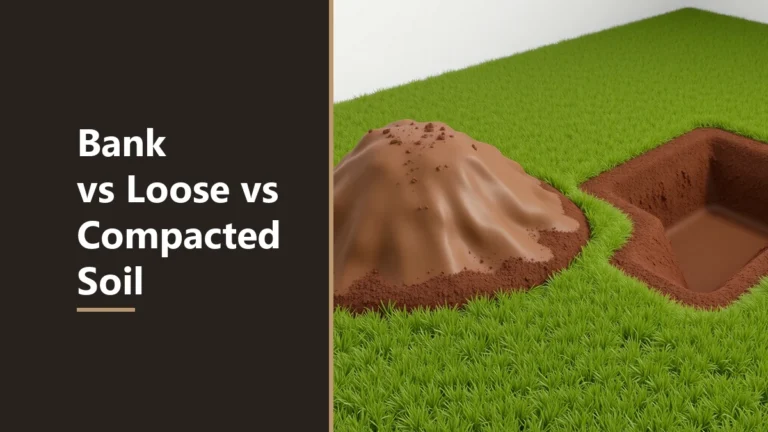
Why does a hole of about 30 cubic yards fill about 37 yards of truck beds, then pack down to about 27 yards of fill? Soil changes volume every time it moves. Bank vs loose cubic yards is the first split; compacted yards are the third state.
A bank cubic yard is soil as it lies in the ground. A loose cubic yard is the same soil after digging, and a compacted cubic yard is after rolling into a fill. The US Army’s FM 5-434 says 1 bank cubic yard of loam becomes 1.25 loose and 0.90 compacted. Sand, clay and rock change by different amounts.
What Do Bank, Loose and Compacted Cubic Yards Mean?
Bank, loose and compacted cubic yards each hold 27 cubic feet of soil, in three states: undisturbed, dug up and rolled into a fill. The US Army manual FM 5-434, Earthmoving Operations (2000) calls them BCY, LCY and CCY.
A bank yard is soil in its natural, undisturbed state. Digging breaks it apart and opens voids, so the same soil takes up more room as loose yards. Compaction squeezes voids back out. FM 5-434 notes that crews commonly compact soil denser than its natural state, and the project specification sets the required density.
The manual treats the bank yard as the usual unit of comparison. Wisconsin’s WHRP G22-05 research report (2023) uses the same three states: volume generally grows from bank to loose and shrinks from bank to compacted.
Our soil swell calculator turns a hole’s length, width and depth into all three volumes at once. This guide covers the published factors behind numbers like these, and where the sources disagree.
Bank vs Loose Cubic Yards: How Much Each Soil Swells
Swell runs from 11 percent for sand or gravel to 50 percent for blasted rock in FM 5-434’s Table 1-1. So 100 bank cubic yards leave the hole as 111 to 150 loose yards. Swell is the percentage increase in volume from bank to loose.
Per 100 bank cubic yards, Table 1-1 gives:
- Sand or gravel: 111 loose, 95 compacted.
- Loam (common earth): 125 loose, 90 compacted.
- Clay: 143 loose, 90 compacted.
- Blasted rock: 150 loose, 130 compacted. Coral, which the manual compares to lime rock, has the same values.
FM 5-434 attaches a caution to its weight table (Table 1-2): the numbers are averages, and they vary with grain size, moisture and compaction. The manual says to test a sample when you need an exact weight.
Why Do Published Swell and Shrink Factors Disagree?
Published factors disagree because each source tested different soils in different places. In the WHRP G22-05 review, state DOT shrinkage factors ran 0 to 50 percent by soil type. Expansion factors ran 0 to 72 percent by rock type.
| Measure | US Army FM 5-434 (2000) | FHWA table (2022) | State examples | Calculator setting |
|---|---|---|---|---|
| Common earth or loam, shrink | 10 (0.90) | Dry loam 12, damp loam 4 | West Virginia 15; NCDOT (2021) 15 to 20 mountains, 25 to 30 coastal plain | 15 |
| Clay, swell to loose | 43 (Table 1-1); 40 (Table 1-2) | Dry 50, damp 67 | Wisconsin tested clays 26 to 58 | 35 |
| Sand, swell to loose | 11 (Table 1-1); 10 to 15 (Table 1-2) | Dry 11, wet 5 | Wisconsin clean sands 4 to 8; Alaska DOT (1983) 5 | 15 |
| Rock in a fill, gain over bank | Blasted rock 30 | Limestone 36, sandstone 34, shale 49, granite 43 | NCDOT 0 by default; West Virginia limestone or sandstone 15, shale 5 | 0 |
FM 5-434 even differs with itself on clay: 43 percent swell in Table 1-1 and 40 in Table 1-2. A 1988 FHWA table attached to an Ohio project memo warns that its factors vary by plus or minus 33 percent.
State practice varies too. As compiled by WHRP, Tennessee DOT sets earth shrinkage at 30 to 50 percent for light cuts and fills of 1 to 2 feet. For heavy cuts and fills it drops to 10 percent.
Load Factor, Shrinkage and Expansion: Three Ways to Say It
A load factor converts loose yards back to bank yards. By our arithmetic it equals 1 / (1 + swell). Swell of 25 percent gives 0.80, matching FM 5-434’s loam factor.
FM 5-434 multiplies loose yards by the load factor to get bank yards. Its example is a scraper carrying 25 loose yards of dry clay, which holds 18 bank yards (25 x 0.72). Our arithmetic gives 1 / 1.4 = 0.714, so the printed 0.72 is the manual’s own rounding.
Shrinkage comes in two styles. FM 5-434 and the WHRP report’s Equation 1 measure shrinkage against bank volume. WisDOT instead expands the fill: it adds a percentage to the compacted volume to find the bank soil needed. Its typical values run 10 to 15 percent for clean sands and 25 to 35 for silty clays and clays.
By our arithmetic, 15 percent shrinkage equals 1 / 0.85 – 1 = 17.6 percent expansion of the fill. Ten percent shrinkage equals 11.1 percent expansion. The soil is the same, so ask which style a figure uses before you plug it in.
How Much Bank Soil Fills 100 Compacted Cubic Yards?
Filling 100 compacted cubic yards with loam takes about 111 bank yards and 139 loose yards of hauling, by FM 5-434’s factors. NCDOT’s Roadway Design Manual also works backward. It applies a shrinkage factor to the earth portion of the embankment to find the material needed.
- Bank soil needed. 100 / 0.90 = 111.1 bank cu yd, the same as FM’s compacted-to-bank factor of 1.11.
- Loose soil hauled. 111.1 x 1.25 = 138.9 loose cu yd.
- Truckloads. 138.9 / 12 = 11.57, so 12 loads. The 12 loose cu yd per load is an assumption (the calculator’s default), not a sourced truck size.
The calculator’s common earth setting uses 15 percent shrink, not FM’s 10. That gives 100 / 0.85 = 117.6 bank yards and 147.1 loose yards, and 147.1 / 12 = 12.25, so 13 loads. One factor adds a truckload.
The calculator’s default hole, 20 x 10 x 4 ft, is 800 cubic feet, or 29.63 bank yards and 37.04 loose. FM’s loam factor leaves 26.67 compacted yards; the calculator’s setting leaves 25.19. Both need 4 loads at 12 yards.
Why Rock Takes More Room in a Fill Than in the Ground
Rock usually fills more space after placement than it held in the ground. FM 5-434 turns 100 bank yards of blasted rock into 130 compacted yards. The 1988 FHWA table in the Ohio memo lists embankment gains of 36 percent for limestone, 34 for sandstone and 49 for shale.
Some highway agencies design with lower values. West Virginia’s Design Directive 406 (1998) uses 15 percent shrinkage for soil, 5 percent swell for shale, and 15 percent swell for limestone or sandstone.
An HDR consultant memo for Ohio’s Portsmouth Bypass (2008) is a project memo, not ODOT policy. It recommended 10 percent shrink for common soil, 10 percent swell for shale and 20 percent for thick sandstone and limestone. Weighted by the project’s mix, that came to 14.3 percent, rounded to a 15 percent composite.
North Carolina starts from zero. NCDOT’s Roadway Design Manual computes hard rock one to one unless the Geotechnical Engineering Unit says otherwise. An archived 2004 NCDOT memo adds a rock swell factor for rock-heavy mountain jobs. The A-10 (I-26) project used 15 percent soil shrinkage and 30 percent hard rock swell.
Truckloads: Count by Volume, Then Check Weight
Count truckloads in loose yards, then check the weight, because heavy soil can reach a truck’s weight rating first. FM 5-434 notes that Army dump trucks are rated by weight. Its advice is to make sure “the volumetric load does not exceed the gravimetric capacity of the truck.”
By our arithmetic with FM 5-434’s loose weights (Table 1-2), an assumed 12-yard load weighs:
- Dry earth (loam or silt), 1,900 to 2,200 lb per loose yard: 11.4 to 13.2 tons.
- Wet clay, 2,400 to 3,000 lb per loose yard: 14.4 to 18.0 tons.
- Wet earth (loam or silt), 2,800 to 3,200 lb per loose yard: 16.8 to 19.2 tons.
For 100 bank yards at 12 yards a load, FM’s factors give 10 loads of sand, 11 of loam, 12 of clay and 13 of blasted rock. Twelve yards is an assumption, not a standard size. Ask your hauler for the truck’s rated payload; legal weight limits are outside this guide.
Your project specification and engineer decide which factors apply, and the permitting agency (a building department or state DOT district office) sets local rules.
Enter your hole size, soil and truck in the bank, loose and compacted soil calculator, then compare the result with your project’s factors.
FAQs About Bank, Loose and Compacted Soil
Is a bank cubic yard bigger than a loose cubic yard?
No. Every cubic yard is 27 cubic feet. The difference is the soil inside: one bank yard of loam fills about 1.25 loose yards after digging, according to the US Army’s FM 5-434.
Why does compacted soil take up less room than soil in the ground?
Compaction squeezes out air voids, often past the soil’s natural density. FM 5-434 lists loam and clay at 0.90 compacted yards per bank yard, and sand or gravel at 0.95.
Does wet soil swell more than dry soil?
The sources do not show that. FM 5-434 lists the same 10 to 15 percent swell for wet and dry sand, and an FHWA table lists less swell for wet sand. Wet soil does weigh more per yard.
What is a load factor in earthmoving?
A load factor converts loose yards to bank yards. It equals 1 divided by 1 plus the swell, so 25 percent swell gives 0.80, the loam figure in US Army FM 5-434.
How many truckloads is 100 bank cubic yards of clay?
About 12 loads at an assumed 12 loose yards per truck. FM 5-434 turns 100 bank yards of clay into 143 loose yards, and 143 divided by 12 is 11.92. Check each load’s weight too.
Does rock shrink when it is compacted in a fill?
Usually not. FM 5-434 puts blasted rock at 1.30 compacted yards per bank yard, and an FHWA table lists rock fills 34 to 49 percent larger. NCDOT designs hard rock one to one unless its geotechnical unit says otherwise.
Which shrink factor should I use for my own project?
Use the factor in your project specification or geotechnical report. Published values differ: FM 5-434 gives loam 10 percent, West Virginia uses 15 for soil, and NCDOT (2021) lists 25 to 30 on the coastal plain.
Sources and Further Reading
References Used in This Article
- US Army, FM 5-434 Earthmoving Operations (Headquarters, Department of the Army, 2000), mirror copy at vulcanhammer.net, chapters 1 and 10, accessed 2026-11-15.
- North Carolina DOT, Roadway Design Manual, Part I Chapter 19, Earthwork, accessed 2026-11-15.
- Wisconsin Highway Research Program, WHRP G22-05, Weight-Volume Relationships and Conversion Factors for Soils and Aggregates of Wisconsin (2023), accessed 2026-11-15.
- West Virginia DOH Design Directive 406, Earthwork Factors (1998), attached to the HDR Earthwork Factors project memo, SCI-823 Portsmouth Bypass, Ohio DOT District 9 (2008), accessed 2026-11-15.
- North Carolina DOT Geotechnical Engineering Unit, Shrink/Swell Factors memo (2004, archived), accessed 2026-11-15.
The factors here are published averages from Army and state highway sources, not test results for your soil. Use your project’s own numbers for real work. Reviewed for accuracy by Prof. Dr. Khalil Mudassar, PhD. Last updated 2026-11-15.

Shakeel Muzaffar is the Founder and Editor-in-Chief, with over 15 years of experience in digital publishing and online tool development. He oversees editorial quality and formula verification to ensure accurate, practical, and easy-to-use calculators.