
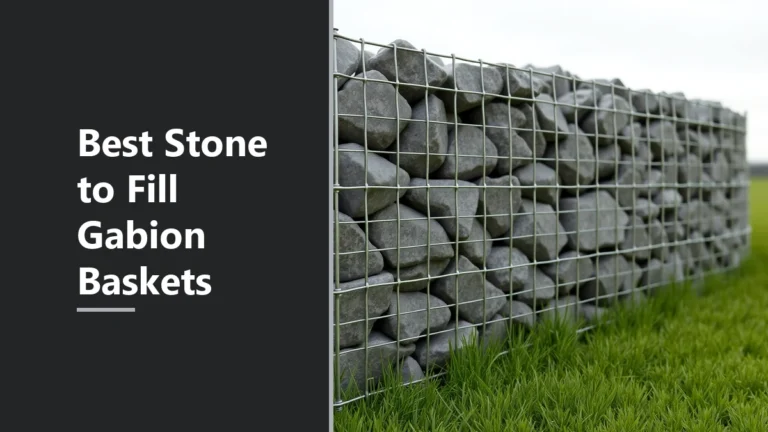
What separates good gabion fill stone from rock that bulges, sags or slips through the wire? Four agency specs answer in slightly different ways, and this guide sets them side by side.
The best gabion fill stone is hard, durable rock larger than the mesh openings. The USACE federal guide spec lists 4 to 8 in for gabions. Caltrans allows up to 12 in in baskets 18 in or taller. The specs read here all set a floor near 4 in. Your project spec and engineer decide.
What Size Should Gabion Fill Stone Be?
Most specs put gabion fill stone at roughly 4 to 8 in, but the top size changes by agency and basket height. The federal guide spec UFGS-31 36 00 (USACE, February 2021) lists 4 to 8 in (100 to 200 mm) rock for gabions 12 in and up.
Caltrans, in its 2018 Standard Specifications Section 72-16 (California), sizes rock by basket height. Baskets 18 in or taller take rock that all passes a 12 in screen, with 0 to 5 percent passing a 4 in screen. Baskets 12 in tall cap the rock at 8 in, with the same 4 in floor.
NCDOT special provision SPD 16-150 (North Carolina, rev. 2024) calls for Class B stone from its plain riprap section and bans stone under 4 in. It sets no top size of its own. Austroads ATS 5150, an Australian and New Zealand spec, sets gabion fill at 100 to 250 mm, about 3.9 to 9.8 in.
UFGS lets up to 5 percent of the rock run oversize and 5 percent undersize by weight. Oversize rock must still leave three or more layers of rock in each gabion compartment. In a 36 in basket, that points to rock no bigger than about 12 in. In an 18 in unit, it points to about 6 in. That is our arithmetic, not a stated limit. Undersize rock goes in the interior, never on an exposed face.
How Does Gabion Fill Stone Size Relate to the Mesh Opening?
Each stone must be bigger than the mesh openings, and it must stay bigger as it weathers. UFGS says rock sizes should be chosen so pieces cannot fall through the mesh. It also rejects rock that would break down to sizes smaller than the mesh opening, and it asks for delivery methods that limit breakage.
ASTM D6711, the standard practice for specifying gabion rock, makes the same point on its free abstract page. UFGS adds that rock size depends on both the mesh size and the thickness of the structure.
Austroads gives the mesh numbers. Its hexagonal gabion mesh is a nominal 80 x 100 mm, and its welded mesh is no larger than 75 x 75 mm.
You may see a rule that stone should be twice the mesh opening. None of the specs read for this article state that ratio. Use the size range in your project spec, and ask the basket maker for the real opening. Once the stone is chosen, the Gabion Calculator for baskets and fill tons handles the counting.
Which Rock Quality Rules Do Gabion Specs Use?
Gabion specs ask for hard, durable rock that will not crack or break down inside the wire. Caltrans 72-2.02B sets an apparent specific gravity of at least 2.5, absorption of 4.2 percent or less, and a durability index of at least 52. Caltrans relaxes the absorption limit when the durability absorption ratio (DAR) is above 10, and the durability limit when DAR is above 24.
Shape is a real disagreement. UFGS accepts hard rock anywhere from angular to round. Austroads requires at least two broken or angular faces. Caltrans bars rounded boulders on slopes steeper than 2:1 for rock slope protection, but whether that rule reaches gabion rock is not verified.
| Source | Shape | Density test | Other limits |
|---|---|---|---|
| USACE UFGS-31 36 00 (federal guide spec, 2021) | Angular to round accepted | No filled-basket density given | No more than 5 percent dirt, sand, clay and rock fines by weight; ASTM C33 quality; freeze-thaw testing |
| Caltrans 2018 Sections 72-16 and 72-2.02B (California) | Not set in Section 72-16 | Apparent specific gravity 2.5 min; filled gabion 110 lb per cu ft min | Absorption 4.2 percent max; durability index 52 min |
| Austroads ATS 5150 (Australia, non-US) | Two broken or angular faces min | Apparent particle density 2.5 t/m3 min | Wet strength 100 kN min; wet/dry variation 35 percent max; no laminations or cracks |
NCDOT asks for durable stone free of cracks, seams and other defects that would shrink it to a size the basket cannot hold. What about recycled concrete? No source read for this article allows or bans it as gabion fill, so your project spec decides.
How Do You Place Stone in Lifts and Tie the Cells?
Fill in shallow lifts and add internal wires as the stone rises, so the face cannot push out. Here is how each source sets it up:
- USACE UFGS. Double twisted gabions fill in 1 ft lifts, and no cell may sit more than 1 ft higher than its neighbor. Gabions 3 ft or taller get stiffeners or cross ties on the front and sides at 1/3 and 2/3 of the height. Units 1.5 ft tall do not need them. Welded gabions get stiffeners every 12 in of height, set diagonally across corners 12 in from the corner.
- Caltrans 2018. Rock goes in 12 in layers in 36 in gabions and 9 in layers in 18 in gabions. Internal connecting wire (13.5 gauge minimum) or preformed stiffeners go in before more layers are added.
- Austroads ATS 5150. Fill one third, add braces at nominal 330 mm horizontal centres, fill to two thirds and brace again. Retaining structures use 250 mm centres.
- NCDOT SPD 16-150. Connecting wires match the mesh wire and are spaced evenly in each cell.
How Do You Keep the Face Flat and the Voids Low?
Hand-place the visible face, use well-graded stone and limit the drop height. Caltrans 72-16.03C tells crews to avoid bulges and minimize voids. It adds a plain rule: “Sharp rocks must not project through the wire mesh.”
UFGS asks for some hand placement on visible faces so the void ratio stays low. For welded gabions, it adds well-graded stone and no large rocks. NCDOT allows filling by hand or machine, as long as voids stay to a minimum.
Drop height is capped. UFGS sets a maximum drop of 3 to 4 ft, and NCDOT sets 36 in. At the top, UFGS overfills by about 1 to 2 in for settlement. Caltrans says to overfill slightly so the lid rests on rock.
Austroads uses hand sorting during mechanical filling. It calls for refilling where bulges or dips exceed 50 mm under a 3 m straight edge.
How Many Tons of Fill Stone Does a Gabion Wall Take?
A 20 by 3 by 3 ft wall takes about 10 tons of stone, more if you fill every basket you buy. The 3 x 3 x 3 ft basket matches the Caltrans cubical standard of 36 by 36 by 36 inches. Caltrans also lists a 12 by 18 by 36 inch size. Here is the tool’s first preset, worked by hand:
- Count baskets. 20 ft / 3 ft = 6.67, rounded up to 7 baskets.
- Find the wall volume. 20 x 3 x 3 = 180 cu ft, and 180 / 27 = 6.67 cu yd.
- Convert to tons. 6.67 x 1.5 tons per cu yd = 10.00 tons. Adding 10 percent gives 11.00 tons. The 1.5 density and the 10 percent are tool settings, not source figures.
- Check against Caltrans. 1.5 tons per cu yd equals 3,000 / 27 = 111.1 lb per cu ft. That is just above the Caltrans minimum of 110 lb per cu ft for a filled gabion. At exactly 110, the wall takes 180 x 110 = 19,800 lb, or 9.90 tons.
- Fill the baskets you buy. Seven baskets hold 7 x 27 = 189 cu ft, or 7 cu yd. That is 10.50 tons at 1.5, or 189 x 110 = 20,790 lb (about 10.40 tons) at the Caltrans minimum. Here the tool’s 10 percent allowance covers the gap.
No source read gives a void percentage for gabion fill. As our own arithmetic, solid stone with a specific gravity of 2.65 weighs 165.36 lb per cu ft. With 30, 35 or 40 percent voids, the same 180 cu ft wall takes 10.42, 9.67 or 8.93 tons. At that specific gravity, the Caltrans 110 minimum leaves room for about 33.5 percent voids.
Caltrans also lets the engineer order a weight check: fill the smallest standard basket with project rock and weigh it on certified scales. Local rules, permits and inspectors may also apply, and your engineer or supplier makes the final call.
Enter your wall length, height and thickness in the gabion basket and fill stone calculator, then compare its density setting with your supplier’s figure.
FAQs About Gabion Fill Stone
Can you use round river rock in gabion baskets?
It depends on the spec. The USACE guide spec accepts hard rock from angular to round, while Austroads requires at least two broken or angular faces. Follow your project spec and ask your engineer.
Can I fill gabions with broken concrete?
None of the specs read for this article allow or ban recycled concrete as gabion fill. Your project spec, engineer or local inspector decides, so ask before you order it.
What is the smallest stone allowed in a gabion?
About 4 inches. UFGS starts at 4 in, and NCDOT bans stone under 4 in. Caltrans lets only 0 to 5 percent pass a 4 in screen, and Austroads sets a 100 mm minimum.
How far can stone be dropped into a gabion?
The USACE guide spec caps the drop at 3 to 4 feet. North Carolina’s NCDOT provision caps it at 36 inches. Check your own project spec for its limit.
Do 18-inch gabions need internal stiffeners?
Not under the USACE guide spec, which skips stiffeners in 1.5 ft double twisted units. Caltrans fills 18 in gabions in 9 in layers and sets connecting wires or stiffeners before each new layer.
How much does a filled 3 x 3 x 3 ft gabion weigh?
At the Caltrans minimum of 110 pounds per cubic foot, a 27 cubic foot basket weighs 2,970 pounds, about 1.49 tons. Denser fill weighs more.
How much dirt or fines can gabion stone contain?
The USACE guide spec allows no more than 5 percent by weight of dirt, sand, clay and rock fines. It also allows up to 5 percent undersize rock, placed inside the basket.
Sources and Further Reading
References Used in This Article
- USACE, UFGS-31 36 00 Gabions (February 2021), federal guide specification, accessed 2026-11-15.
- Caltrans, Standard Specifications 2018 edition, Section 72-16 Gabions and 72-2.02B (California), accessed 2026-11-15.
- NCDOT, Special Provision SPD 16-150 Gabion Baskets, rev. 2024 (North Carolina), accessed 2026-11-15.
- Austroads, ATS 5150 Construction of Gabions and Rock Mattresses (Australia and New Zealand, non-US), accessed 2026-11-15.
- ASTM, D6711/D6711M-22 Standard Practice for Specifying Rock to Fill Gabions (abstract page only), accessed 2026-11-15.
These figures come from the agency specs listed, read on 2026-11-15, and later editions may differ. Your project spec, engineer and supplier set the rock for your job. Reviewed for accuracy by Prof. Dr. Khalil Mudassar, PhD. Last updated 2026-11-15.

Shakeel Muzaffar is the Founder and Editor-in-Chief, with over 15 years of experience in digital publishing and online tool development. He oversees editorial quality and formula verification to ensure accurate, practical, and easy-to-use calculators.