
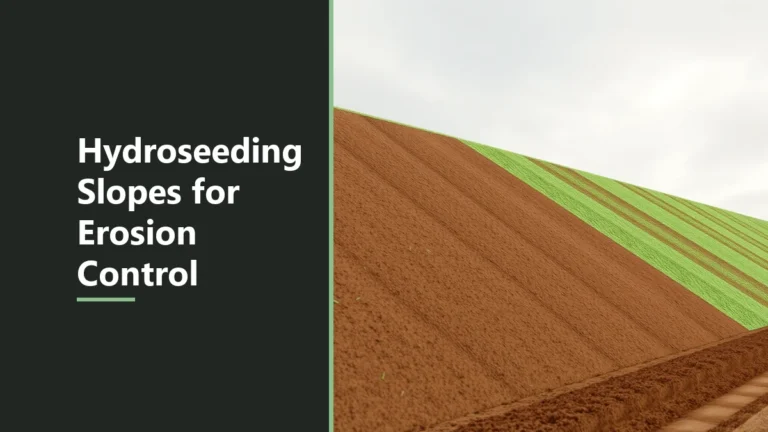
Why does one state manual call for 2,000 pounds of hydraulic mulch per acre when hydroseeding slopes, while another calls for 3,500? Slope steepness, mulch type and the agency writing the rule all matter. Here is where four state manuals agree and where they split.
Hydroseeding slopes means spraying seed, fertilizer and a fiber mulch slurry onto bare ground. Mulch rates rise with steepness. South Carolina DOT steps from 2,000 lb per acre on slopes 4:1 or flatter to 3,500 lb between 2:1 and 1:1. Caltrans uses 3,500 lb for bonded fiber matrix when the maker gives no rate. Local specs decide.
Hydraulic Mulch or Hydroseed: What Is Being Sprayed?
Hydraulic mulch is a sprayed slurry of fiber and binder that shields bare soil; hydroseed is a similar slurry with seed and fertilizer added. The Caltrans Construction Site BMP Manual (California, March 2024) treats them as two practices, SS-3 and SS-4.
Under SS-3, temporary hydraulic mulch must be at least 50 percent wood fiber, with the rest cellulose or another fiber. Under SS-4, hydroseed mixes wood, fiber, seed, fertilizer and a stabilizing emulsion. The manuals name these mulch types:
- Wood fiber. NCDEQ (North Carolina) also calls it wood cellulose and says not to use it in hot, dry weather.
- Bonded fiber matrix (BFM). Caltrans defines it as 100 percent wood fiber with tackifier bonded or prepackaged by the manufacturer.
- Other fibers. Washington Ecology’s 2014 manual allows recycled cellulose, hemp, kenaf, compost or blends.
- Paper. Caltrans does not permit paper mulches on its jobs.
The sources also disagree on sprayed fiber used by itself. NCDEQ says wood fiber mulch does not give enough erosion protection alone. Caltrans lists temporary hydraulic mulch as a stand-alone stabilization option but notes it lasts only part of a growing season.
| Attribute | Standard hydraulic mulch | Bonded fiber matrix (BFM) |
|---|---|---|
| Fiber | Caltrans: at least 50 percent wood fiber | Caltrans: 100 percent wood fiber plus tackifier |
| Rate | Caltrans: 2,000 lb/acre if the maker gives none; Ecology 2014: 1,500 minimum | Caltrans: 3,500 lb/acre if the maker gives none; Ecology 2014: 3,000 minimum |
| Tackifier | Ecology 2014: 3 percent; Caltrans: per manufacturer | Ecology 2014: about 10 percent; Caltrans: 10 percent minimum, factory bonded |
| Dry time before rain | Caltrans: 24 hours or more (wood fiber) | Ecology 2014: 24 to 36 hours for most products |
How Many Pounds of Mulch Per Acre Do Slopes Need?
The manuals reviewed put hydraulic mulch between 1,000 and 3,500 pounds per acre, rising with slope and product strength. Only South Carolina DOT (SCDOT) ties the rate to slope in a stepped table.
SCDOT’s Storm Water Quality Design Manual is a 2015-era PDF with no printed edition date. Its Appendix C sets these rates for hydraulic erosion control products (HECPs):
- Type 1, slopes 4H:1V or flatter: 2,000 lb per acre.
- Type 2, steeper than 4:1 up to 3:1: 2,500 lb per acre.
- Type 3, steeper than 3:1 up to 2:1: 3,000 lb per acre.
- Type 4, steeper than 2:1 up to 1:1: 3,500 lb per acre.
The other manuals use one default plus a stronger product for steep ground. Caltrans uses 2,000 lb per acre for hydraulic mulch and 3,500 for BFM, but only when the manufacturer gives no rate. Ecology’s 2014 manual sets minimums of 1,500 and 3,000. NCDEQ lists wood fiber at 0.5 to 1 ton (1,000 to 2,000 lb) per acre, so its low end is half the Caltrans default.
The hydroseed calculator offers two mulch settings: 45 lb per 1,000 sq ft (about 1,960 lb per acre, our arithmetic) and 80 (about 3,485). The 80 setting matches SCDOT’s steepest band and the Caltrans BFM default, not a typical 3:1 slope.
What Do the Numbers Look Like on a 10,000 Sq Ft Slope?
On a 10,000 sq ft slope face, the source rates work out to about 344 to 804 pounds of mulch (our arithmetic). Divide the per-acre rate by 43.56 for pounds per 1,000 sq ft, then multiply by 10.
- Ecology 2014 minimum. 1,500 / 43.56 = 34.44 lb per 1,000 sq ft, so 344.4 lb.
- Caltrans default or SCDOT Type 1. 2,000 / 43.56 = 45.91, so 459.1 lb.
- SCDOT Type 2. 2,500 / 43.56 = 57.39, so 573.9 lb.
- SCDOT Type 3 or Ecology BFM minimum. 3,000 / 43.56 = 68.87, so 688.7 lb.
- SCDOT Type 4 or Caltrans BFM default. 3,500 / 43.56 = 80.35, so 803.5 lb.
The tool’s default preset uses 5,000 sq ft, a 500-gallon tank and, per 1,000 sq ft, 6 lb seed, 45 lb mulch and 1.5 lb guar. It returns 30.0 lb of seed, 225 lb of mulch, 7.5 lb of guar and 450 gallons of water in one load. All of those are tool settings.
The water figure is the tool’s own assumption of 2 gallons per pound of mulch. No source we read gives a water ratio; Caltrans says to follow the manufacturer. Also measure the slope face, not the plan footprint. A 2:1 face is about 1.118 times its plan area (our arithmetic), so the face is nearly 12 percent larger than the plan measurement.
One-Step vs Two-Step: Hydroseeding Slopes in Phases
A one-step job sprays seed, fertilizer, mulch and tackifier in a single lift; Washington Ecology’s 2014 manual offers a two-phase option that splits the mulch. The reason is seed contact: Ecology estimates only about one third of hydroseeded seed reaches the soil surface.
- Phase 1: all of the seed and fertilizer with 25 to 30 percent of the mulch and tackifier.
- Phase 2: the rest of the mulch and tackifier, sprayed over the first lift.
Take 10,000 sq ft at the 1,500 lb per acre minimum (344.4 lb). Phase 1 gets 86.1 to 103.3 lb and Phase 2 gets 241.0 to 258.3 lb (our arithmetic).
Ecology also allows one full lift with straw blown on top at 800 to 1,000 lb per acre, held with tackifier. That is about 183.7 to 229.6 lb of straw on 10,000 sq ft. The manual says both options raise cost moderately but greatly improve establishment. It also suggests up to 50 percent more seed for hydroseeding.
How Do the Manuals Handle Tackifier?
Tackifier is the binder that holds fiber to the slope, and each manual doses it differently.
- Washington Ecology (2014): hydroseed needs at least 1,500 lb per acre of mulch with 3 percent tackifier, and BFM about 10 percent. The manual does not say what the 3 percent is measured against.
- Caltrans (California): standard hydraulic mulch follows the manufacturer’s tackifier instructions for slope, soil and wind. BFM tackifier must be bonded or prepackaged, at least 10 percent of combined dry weight.
- SCDOT (South Carolina): all HECP components must be pre-packaged by the manufacturer, and field mixing is not accepted.
- NCDEQ (North Carolina): wood fiber does not require tacking, though tackifiers or binders can go in the slurry.
The calculator’s guar setting of 1.5 lb per 1,000 sq ft is a tool setting, not a source figure. Where a spec requires pre-packaged or bonded products, pick the tool’s pre-blended option instead of adding guar.
When to Spray a Slope and How to Water It
Spray when the slurry can dry before rain and enough season remains for seed to establish. Caltrans says hydroseed works alone only when the season allows; otherwise pair it with a soil binder or mulch.
- Preparation. Caltrans requires a crimping or punching roller, or track walking, on all slopes first. Ecology 2014 bars smoothing seeded slopes steeper than 4H:1V.
- Mixing. Caltrans requires spraying within 60 minutes of adding seed to the tank and all materials for one area within 72 hours. Its tanks need continuous agitation and at least 1,000 gallons unless the resident engineer allows smaller; the tool defaults to 500.
- Seasons. Ecology’s western Washington windows are April 1 to June 30 and September 1 to October 1.
No source read gives a watering schedule. Ecology 2014 requires irrigation for July and August seedings until 75 percent grass cover, and says not to water to the point of runoff. Caltrans notes dry periods may need supplemental irrigation.
When Is a Slope Too Steep or Long for Hydromulch Alone?
A slope outgrows sprayed mulch when it is long, very steep or carries concentrated flow, and each manual draws that line differently. Caltrans puts it plainly: “Steep slopes are difficult to protect with temporary seeding.”
- SCDOT caps continuous HECP slope length at 50 feet; longer slopes need slope interruption devices. It also bars HECPs from channels and concentrated flow.
- Ecology 2014 requires mulch in the wet season on slopes steeper than 3H:1V with more than 10 feet of vertical relief.
- Caltrans notes cellulose fiber alone may fail on steep slopes or coarse soils.
Past those limits, the manuals turn to rolled erosion control products. Ecology 2014 calls for nets and blankets in ditches and swales, and on slopes 2H:1V or steeper with over 10 feet of vertical relief. Seeded hydromulch goes under the blanket first. Caltrans allows hydroseed sprayed perpendicular to the slope over a blanket, and NCDEQ allows wood fiber over an installed net.
Measure the slope face, pick your spec’s rate, then run the numbers in the Hydroseed Calculator.
FAQs About Hydroseeding Slopes
What mulch rate should I use to hydroseed a 2:1 slope?
South Carolina DOT sets 3,000 lb per acre for slopes steeper than 3:1 up to 2:1, and 3,500 lb for slopes steeper than 2:1. Your state spec and product label decide.
Can I spray hydromulch on a slope without seed?
Sometimes. Caltrans lists temporary hydraulic mulch as a stand-alone cover. Washington Ecology’s 2014 manual says hydromulch needs seed and tackifier unless the rate is at least doubled.
How long does hydraulic mulch need to dry before it rains?
Caltrans says wood fiber hydraulic mulch needs 24 hours or more. Washington Ecology’s 2014 manual says most bonded fiber matrix products need 24 to 36 hours. Follow the manufacturer’s drying time.
Is paper mulch allowed for hydroseeding a slope?
Not on Caltrans jobs, which do not permit paper mulches. Washington Ecology’s 2014 manual lists recycled cellulose fiber among allowed mulches. Check what your agency or project spec accepts.
When is the best time to hydroseed in western Washington?
Ecology’s 2014 manual names April 1 to June 30 and September 1 to October 1. July and August seedings need irrigation, and October through March seedings need straw or a blanket.
How much should I water a newly hydroseeded slope?
No source reviewed gives a schedule. Washington Ecology says to water adequately but never to the point of runoff. Caltrans notes dry periods may need supplemental irrigation.
What should I do if parts of the slope fail to grow?
Caltrans says to re-seed, fertilize and mulch failed areas within the planting season, at no less than half the original rates. Ecology 2014 says to reseed areas below 80 percent cover.
Sources and Further Reading
References Used in This Article
- Caltrans, Construction Site BMP Manual, March 2024, SS-3 and SS-4, California, accessed 2026-11-15.
- Washington Ecology, Stormwater Management Manual for Western Washington, Vol. II, December 2014 edition, BMPs C120 to C122; later editions may have changed these rates; accessed 2026-11-15.
- NCDEQ, Erosion and Sediment Control Manual, Practice 6.14 Mulching and its detail sheet (effective 9/1/2023), North Carolina, accessed 2026-11-15.
- SCDOT, Storm Water Quality Design Manual, Appendix C, Table C.1, South Carolina, 2015-era PDF with no printed date, accessed 2026-11-15.
These rates come from four state manuals and change by edition, product and site. Local rules, permits, inspectors and your engineer or supplier decide what applies. Reviewed for accuracy by Prof. Dr. Khalil Mudassar, PhD. Last updated 2026-11-15.

Shakeel Muzaffar is the Founder and Editor-in-Chief, with over 15 years of experience in digital publishing and online tool development. He oversees editorial quality and formula verification to ensure accurate, practical, and easy-to-use calculators.