
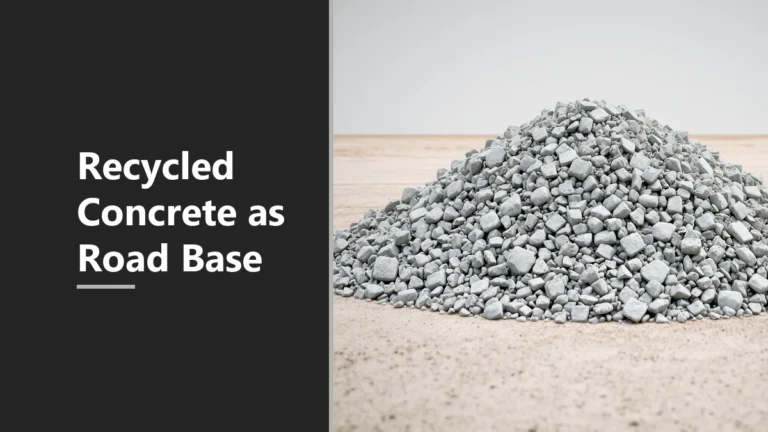
What happens to an old concrete pavement after it is broken up? Much of it can be crushed, screened and laid back down as a recycled concrete base. A 1997 FHWA guideline already counted 20 states using it, and the rules have kept shifting since.
A recycled concrete base is crushed, screened concrete used as granular aggregate base under pavement. FHWA guidance from 1997 says processed material generally exceeds minimum requirements for conventional aggregate. Caltrans and MnDOT allow it in base, but Indiana bans coarse recycled concrete where an underdrain is specified. Check the current spec and ask your engineer.
What Is Recycled Concrete Aggregate?
Recycled concrete aggregate (RCA) is old concrete that has been crushed, stripped of steel and screened into a graded granular material. FHWA’s 1997-era User Guidelines for Waste and Byproduct Materials call it reclaimed concrete material (RCM). Virginia researchers call it crushed hydraulic cement concrete (CHCC). All three names describe the same product.
In the FHWA guideline, a jaw crusher breaks the slabs and magnets remove the steel. The rest is crushed and screened to a gradation such as AASHTO M147 or ASTM D2940. Every particle is crushed, so FHWA says the material locks up well.
Old pavement is rarely pure concrete. FHWA notes that excavated material may include 10 to 30 percent subbase soil and asphalt pavement. For composite pavements, it recommends capping reclaimed asphalt pavement (RAP) at 20 percent to protect bearing strength.
FHWA Technical Advisory T 5040.37 (2007) also lists granular base, subbase and shoulders as uses for crushed pavement. To size a job, the road base calculator converts area and depth into tons.
Where Do States Allow a Recycled Concrete Base?
Several state DOTs accept recycled concrete in aggregate base, but each draws its limits differently, especially near underdrains. In 1997, FHWA counted 20 states using it in granular base. Treat that count as history, not a current list.
- California. Caltrans 2024 Standard Specifications, Section 26, list processed reclaimed portland cement concrete (PCC) among allowed aggregate base materials.
- Minnesota. MnDOT Spec 3138 lets a contractor substitute recycled aggregates, including recycled concrete. MnDOT’s Concrete Management Appendix A (July 1, 2015) allows 100 percent recycled concrete in base and shoulders, but not on gravel driving surfaces. Our 3138 copy prints no edition date.
- Indiana. INDOT’s 2026 Section 301 says recycled concrete processed into coarse aggregate-sized material shall not be used when an underdrain is specified.
- Virginia. The 2025 VTRC 25-R5 report says a VDOT special provision limits crushed concrete as base where subsurface drainage is present. We did not read the provision itself.
Agency rules change. Check your state’s current spec, and let your engineer, permit office or inspector decide what goes under your project.
What Quality Limits Apply to Recycled Concrete Base?
Quality limits depend on which document you read, because agencies test different properties.
| Measure | FHWA 1997 guideline (federal) | MnDOT Spec 3138, Class 5 (Minnesota) | Caltrans Class 2, 2024 (California) |
|---|---|---|---|
| LA abrasion loss | Coarse RCM typically 20 to 45 percent | 40 percent max for virgin carbonate rock; no recycled line | No requirement |
| Asphalt content | RAP 20 percent max | Bitumen 3.5 percent max of the composite | Reclaimed asphalt concrete is an allowed material |
| Passing No. 200 sieve | No figure; coarse RCM has lower fines | 0 to 6.0 percent when mostly recycled concrete; 3.0 to 10.0 percent when under 25 percent recycled | 0 to 12 percent (operating range 2 to 9) |
| Other limits | CBR 94 to 148 | Brick 1.0 percent, other objectionables 0.3 percent max | R-value 78, sand equivalent 22, durability index 35 (minimums) |
LA abrasion shows the split most clearly. FHWA reports coarse recycled concrete losing 20 to 45 percent in the ASTM C131 test, somewhat higher than high-quality conventional aggregate. A six-year Long Island, New York study averaged 36.5 percent over 112 tests. MnDOT caps virgin carbonate rock at 40 percent but lists no LA limit for recycled material. Caltrans Class 2 sets none.
Strength looks good. FHWA lists CBR values of 94 to 148, against a typical 100 for crushed limestone. It also calls the material nonplastic and not frost susceptible.
Asphalt limits use different yardsticks. FHWA’s 20 percent RAP cap is a share of the material. MnDOT’s 3.5 percent is bitumen content, so do not convert one into the other.
Does a Recycled Concrete Base Drain Well?
A coarse recycled concrete base can drain well, but its fines and its chemistry decide whether it keeps draining.
FHWA’s 1997 guideline calls coarse RCM more permeable than conventional granular material, because it has fewer fines. Virginia’s Phase 1 lab work (VTRC 21-R12, summarized in VTRC 25-R5) tested crushed concrete with about 8 percent fines. It drained like virgin aggregate of the same gradation. In that test, gradation mattered more than the material name.
Chemistry is the second issue. FHWA reports tufa-like deposits, a white powdery precipitate, that clogged some subdrains and blinded geotextile filters. The deposit appears to be Portlandite from unhydrated cement, calcium carbonate from free lime, or both. FHWA adds that the problem is not universal.
FHWA’s fixes: wash coarse RCM to remove dust, as Ohio required. Avoid material with much unhydrated cement or free lime. Test leachate where subdrains are involved, and keep trench geotextile off the drainage path out of the base.
What Did Virginia’s Field Trial Find?
Virginia’s three-year field trial found that geotextile edgedrains kept working beside crushed concrete, though some precipitate formed. The VTRC 25-R5 study (George Mason University, February 2025) built seven sections near Harrisonburg with UD-4 edgedrains.
- Sections used 100 percent crushed concrete, 40/60 and 20/80 blends with virgin aggregate, and a virgin control.
- Unpaved crushed concrete left about 2.5 times less tufa on the geotextile than the earlier one-year lab study.
- Precipitate appeared inside pipes in the 100 and 40 percent sections, not the 20 percent or virgin ones. All drains still functioned.
- Fines reached 11 percent in the field. The lab work had flagged about 9 percent as a threshold for notable fines migration.
The lab phase found carbonate content rises as crushed concrete ages and suggested stockpiling it for about a year. It saw no tufa under saturated conditions. Virgin aggregate can precipitate too when it contains carbonates. The report recommends a pilot of 20 percent crushed concrete and 80 percent virgin aggregate.
Why Does the High pH of Recycled Concrete Matter?
Recycled concrete makes contact water strongly alkaline, which matters for metal pipe, drainage fabric and nearby water. FHWA puts it plainly: “The pH of RCM-water mixtures often exceeds 11.”
FHWA warns that at that level, moist RCM can corrode aluminum or galvanized steel pipe it touches. Deicing-salt chlorides and sulfates are possible contaminants too. FHWA cited no apparent leachate problems. Still, some jurisdictions kept stockpiles a minimum distance from water courses because the leachate is alkaline.
Virginia’s field trial recorded a maximum pH of 12.3, above the VDOT 245.03(c) limit for geotextile drainage fabric. The report recommends checking fines, Atterberg limits, mortar content and contact-water pH. Ask your supplier for test data, and leave pipe choices to your engineer.
How Much Recycled Concrete Base Should You Order?
Order weight starts with your supplier’s loose density, and no source we read publishes one for RCA. FHWA says RCA has a lower compacted unit weight than conventional aggregate, so each ton covers more volume. It gives no number, and we found no primary figure for virgin crushed stone.
The closest data point is FHWA’s Long Island study. It found a mean dry density of 129.0 pounds per cubic foot over 143 tests, with no test method stated. Here it is against the calculator’s first preset (our arithmetic):
- Volume. 1,000 sq ft x 6 in / 324 = 18.52 cubic yards.
- Tool default. 18.52 x 1.5 tons per cubic yard = 27.78 tons, then x 1.20 = 33.33 tons to order. The 1.5 density and 20 percent allowance are tool settings, not source figures.
- RCA at the Long Island density. 129.0 x 27 / 2,000 = 1.7415, about 1.74 tons per cubic yard. Then 18.52 x 1.7415 = 32.25 tons, dry and compacted, with no allowance.
- The trap. Entering 1.74 as the density override while keeping the 20 percent allowance gives 18.52 x 1.7415 x 1.2 = 38.70 tons. That counts compaction twice, because the override expects a loose figure.
The calculator’s four base classes all use 1.5 tons per cubic yard, and none is labeled recycled concrete. FHWA says RCA is placed with the same equipment as conventional aggregate, with extra care against segregation. Caltrans requires at least 95 percent relative compaction, with compacted layers no thicker than 0.50 ft. INDOT caps compacted lifts at 6 in and wants 4 to 7 percent moisture.
Try the Road Base Calculator for tons and cubic yards. For RCA, enter your supplier’s loose density in the override field.
FAQs About Recycled Concrete Base
Is recycled concrete a good base material for roads?
Often, yes. FHWA’s 1997 guideline says processed recycled concrete generally exceeds minimum requirements for conventional granular aggregates and reports CBR values of 94 to 148. Your state’s current spec and your engineer still decide.
Can recycled concrete base go next to an underdrain?
It depends on the state. Indiana’s 2026 spec bars coarse recycled concrete when an underdrain is specified. Virginia limits it near subsurface drains, while a 2025 Virginia field study suggests piloting a 20 percent blend.
What is the white powder that forms on recycled concrete?
It is usually tufa, a white, powdery precipitate. FHWA says it appears to be Portlandite from unhydrated cement or calcium carbonate from free lime, and it has clogged some subdrains and geotextile filters.
Does recycled concrete weigh less than crushed stone?
FHWA says recycled concrete has a lower compacted unit weight than conventional mineral aggregate, so a ton covers more volume. No source we read gives a number for virgin crushed stone to compare.
Why do some agencies want recycled concrete washed?
Washing removes dust and reduces tufa. FHWA’s 1997 guideline names Ohio as an agency that required it and recommends washing coarse material used with subdrains.
How much asphalt can be mixed into recycled concrete base?
Limits differ. FHWA recommends at most 20 percent reclaimed asphalt pavement in the material, while MnDOT caps bitumen at 3.5 percent of the composite. Those measure different things, so one does not convert to the other.
What density should I enter for recycled concrete in a road base calculator?
Enter your supplier’s loose density in tons per cubic yard; no source we read publishes one. A compacted dry figure, such as our 1.74 conversion of FHWA data, plus a 20 percent allowance double-counts compaction.
Sources and Further Reading
References Used in This Article
- FHWA, User Guidelines for Waste and Byproduct Materials in Pavement Construction (FHWA-RD-97-148), Reclaimed Concrete Material: Granular Base and Material Description (1997-era federal guidance, archived), accessed 2026-11-15.
- MnDOT, Specification 3138, Aggregate for Surface and Base Courses (no edition date printed on the copy) and Concrete Management, Appendix A (2015), Minnesota, accessed 2026-11-15.
- Caltrans, 2024 Standard Specifications, Section 26 Aggregate Bases, California, accessed 2026-11-15.
- Indiana DOT, 2026 Standard Specifications, Section 301 Aggregate Base, Indiana, accessed 2026-11-15.
- Virginia Transportation Research Council, VTRC 25-R5, Suitability of Using Crushed Concrete Adjacent to Geotextiles in Underdrain Systems, Second Phase (2025 field study), accessed 2026-11-15.
This guide summarizes federal guidance and four state documents; it is not an engineering design. Specs change, so confirm the current edition with your engineer or supplier. Reviewed for accuracy by Prof. Dr. Khalil Mudassar, PhD. Last updated 2026-11-15.

Shakeel Muzaffar is the Founder and Editor-in-Chief, with over 15 years of experience in digital publishing and online tool development. He oversees editorial quality and formula verification to ensure accurate, practical, and easy-to-use calculators.