
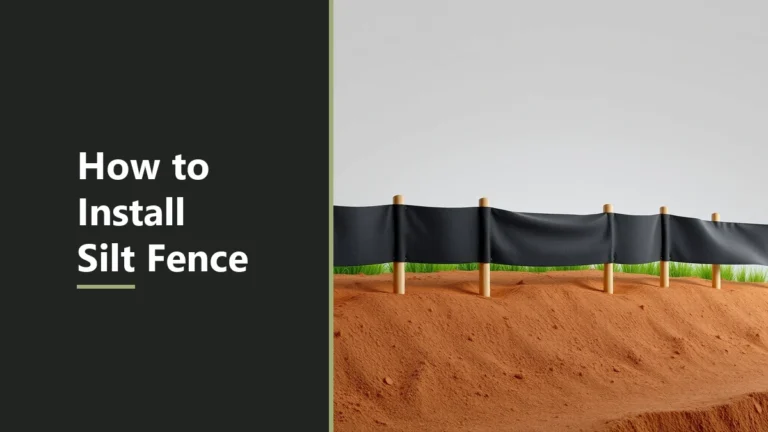
How much silt fence does an acre of bare soil need? The US EPA’s rule of thumb is at least 100 ft of fence for every 10,000 sq ft disturbed, or about 436 ft per acre. Getting that fence to actually hold soil is mostly about where it goes and how deep it is buried.
To install silt fence, run it on the contour along the downslope edge of bare ground and turn both ends uphill. Bury the fabric in a trench about 6 by 6 in (EPA, Ohio) or 4 in wide by 8 in deep (North Carolina). Drive posts 24 in (EPA, NC) or at least 18 in (Ohio), then backfill and compact.
Where Does Silt Fence Go on a Construction Site?
Silt fence goes along the downslope edge of the disturbed ground, on the contour, so runoff reaches it as slow sheet flow. The EPA 2022 Construction General Permit (Part 2.2.3) places perimeter controls on the downslope perimeter, with both ends extended upslope, for example at 45 degrees.
The fence works by holding water back so soil can settle out. The EPA fact sheet puts it plainly: “If the fence doesn’t create a ponding condition, it will not work well.” That is why the manuals keep it out of channels. North Carolina DEQ bars silt fence across ditches and concentrated flow. Iowa SUDAS allows ditch use only where the 2-year flow is 1 cfs or less.
The EPA fact sheet says the drainage area above a fence should usually not exceed a quarter acre. Iowa SUDAS caps it at 1/4 acre per 100 ft of fence. One acre is 43,560 sq ft, so EPA’s rule gives at least 435.6 ft of fence (43,560 / 10,000 x 100). No source gives a formula for a whole site perimeter; they describe the downslope edge plus J-hooks. Once you have a length, the silt fence post and roll calculator turns it into materials.
How Long Can the Slope Above the Fence Be?
The allowed slope length depends on the state, and the steeper the ground, the shorter it gets. North Carolina DEQ allows 100 ft of slope above a fence only where the grade is under 2 percent. On slopes over 20 percent, the limit drops to 15 ft.
Ohio EPA is more generous: 250 ft of slope under 2 percent, 125 ft from 2 to 20 percent, and 50 ft over 20 percent. Iowa SUDAS sets fence spacing on slopes instead. It runs 100 ft on a 10:1 slope, 60 ft on 5:1, 50 ft on 4:1 and 40 ft on 3:1.
The EPA fact sheet gives no slope-length number. On long steep slopes, it suggests one fence near the top and another 6 to 10 ft from the toe. Ohio EPA wants the fence offset at least 10 ft beyond the toe of slopes over 25 percent. Use the rule your permit names, not the most lenient one.
How to Install Silt Fence, Step by Step
Installing silt fence comes down to six steps: lay out the line, trench, set posts, bury the fabric, compact, and fasten. The EPA fact sheet, NC DEQ and Ohio EPA agree on the order but differ on the depths.
- Lay out the line. Keep it on the contour at one elevation (Iowa SUDAS). Turn each end upslope into a J-hook. EPA wants the bottom of each end higher than the top of the middle, and advises against long runs.
- Dig the trench. EPA and Ohio EPA call for about 6 in wide by 6 in deep. NC DEQ uses a narrower, deeper trench, about 4 in wide by 8 in deep. EPA also describes a slicing method with a 12 in slit.
- Drive the posts. EPA and NC DEQ set posts 24 in deep. Ohio EPA uses 2×2 wood posts driven at least 18 in.
- Bury the fabric. NC DEQ puts 12 in of fabric in the trench. Ohio EPA buries 8 to 12 in in a J shape, at least 8 in below grade.
- Backfill and compact. NC DEQ calls for backfilling and compacting. Ohio EPA says to compact both sides.
- Fasten the fabric. For steel posts, EPA calls for three 50 lb ties per post in the top 8 in of fabric. Ohio EPA asks for at least four staples per post.
Iowa SUDAS notes that frozen ground may prevent installation, so schedule the trenching before a hard freeze.
How Do EPA, North Carolina and Ohio Specs Compare?
The three manuals agree on the method but not the numbers. Post spacing runs from 3 ft to 10 ft, depending on the source, the expected load and whether wire backs the fabric.
| Rule | EPA fact sheet (national) | NC DEQ 6.62 (North Carolina) | Ohio EPA 7.3 (Ohio) |
|---|---|---|---|
| Fence height | Supports 24 in of sediment and water | No more than 24 in | 18 in, no more than 24 in |
| Post depth | 2 ft | At least 24 in | At least 18 in |
| Post spacing | 3 to 4 ft where water may overtop; 5 ft in most areas; 6 to 7 ft where load is low | 6 ft max for extra-strength fabric without wire; 8 ft max with wire mesh | 6 ft max; 10 ft wire-supported |
| Runs and joints | Avoid long runs; use J-hooks | Continuous roll; joints only at a post, 4 ft minimum overlap | Ends upslope at 45 degrees; U-segments 300 ft max; splices overlap around posts |
| Sediment cleanout | At half the fence height | As necessary | At about half the height |
Which column applies to you? The one your permit or local manual adopts. Post depth alone differs by 6 in between Ohio and the other two, so check before you buy posts.
How Many Posts and Rolls Does a 400 ft Run Need?
A straight 400 ft run with posts every 6 ft needs 68 posts and four 100 ft rolls at the calculator’s default settings. Here is the arithmetic, then what it leaves out.
- Posts. 400 / 6 = 66.67, rounded up to 67 spaces. Add one end post for 68 posts. At 4 ft spacing the same math gives 101 posts; at 8 ft, 51.
- Rolls. 400 / 100 = 4 rolls, with no allowance for overlap.
- Overlap. NC DEQ wants at least 4 ft of overlap at each joint. Four rolls have 3 joints, so the run needs 400 + 3 x 4 = 412 ft of fabric, more than four rolls hold. The fifth roll adds a fourth joint, for 416 ft in all: 5 rolls (our arithmetic on NC’s rule).
The 100 ft roll and the extra end post are calculator settings, not figures from any source. A 6 ft spacing meets the 6 ft maximums in NC DEQ (without wire) and Ohio EPA. The EPA fact sheet uses 6 to 7 ft only where horizontal load is low.
J-hooks and segment limits add fence and end posts too. Iowa SUDAS limits sections to 200 ft, with a 20 ft J-hook at each end. Read that way, 400 ft becomes two sections with four J-hooks, adding 80 ft (our arithmetic). Under Iowa’s 1/4 acre per 100 ft cap, the 400 ft can serve up to 1 acre of drainage area.
When Should You Inspect, Clean Out and Remove Silt Fence?
Inspect on a fixed schedule and after rain, clean out at about half the fence height, and remove the fence once the ground is stabilized. The rain trigger is where the sources split most.
- EPA 2022 CGP (federal permit). Inspect every 7 days, or every 14 days plus within 24 hours of a storm of 0.25 in or more.
- Ohio EPA. Inspect after each rain of 0.5 in or more, and daily during multi-day rain. Replace the fence when it has not drained within 48 hours.
- NC DEQ. Inspect weekly and after each rain of 1.0 in or more.
For cleanout, the CGP says to remove sediment before it reaches half the above-ground height. EPA’s fact sheet and Ohio EPA also use about half. Iowa SUDAS prefers a different fix: install a new fence at half height rather than cleaning out the old one.
Removal follows stabilization. The EPA fact sheet removes the fence at permanent stabilization, and NC DEQ after the drainage area is stabilized. Iowa SUDAS removes the fabric, posts and sediment at project completion. Local codes and permits decide all of this, so check with your local building or stormwater office before you dig.
Enter your length, post spacing and roll size in the Silt Fence Calculator, then add overlap and J-hook footage by hand.
FAQs About Installing Silt Fence
How deep should a silt fence trench be?
About 6 in deep and 6 in wide under the EPA fact sheet and Ohio EPA. North Carolina DEQ uses a narrower trench, about 4 in wide by 8 in deep, with 12 in of fabric buried in it.
How far apart should silt fence posts be?
It depends on the manual. The EPA fact sheet uses 5 ft in most areas and 3 to 4 ft where water may overtop. North Carolina DEQ allows 6 ft without wire backing and 8 ft with wire mesh.
Can silt fence go across a ditch?
Usually not. North Carolina DEQ bars silt fence across ditches and concentrated flow. Iowa SUDAS allows ditch use only where the 2-year flow is 1 cfs or less.
How much silt fence do I need per acre?
The US EPA rule of thumb is at least 100 ft of fence per 10,000 sq ft of disturbed area. For one acre, which is 43,560 sq ft, that works out to at least 435.6 ft.
Why do the ends of a silt fence turn uphill?
Turned-up ends are called J-hooks. The EPA fact sheet says to keep the bottom of each end higher than the top of the middle. The EPA 2022 Construction General Permit says to extend both ends upslope, for example at 45 degrees.
When should sediment be removed from a silt fence?
Before it reaches half the above-ground height, under the EPA 2022 Construction General Permit. Iowa SUDAS prefers installing a new fence at that point instead of cleaning out the old one.
How much rain triggers a silt fence inspection?
It depends on the rules you work under. On its 14-day schedule, the EPA Construction General Permit uses 0.25 in. Ohio EPA uses 0.5 in, and North Carolina DEQ uses 1.0 in.
Sources and Further Reading
References Used in This Article
- US EPA, Silt Fences, Stormwater Best Management Practice fact sheet (EPA-832-F-21-028AA, December 2021), accessed 2026-11-15.
- North Carolina DEQ, Erosion and Sediment Control Design Manual, Practice 6.62 Sediment Fence, accessed 2026-11-15.
- Iowa SUDAS Design Manual, Section 7E-14, Silt Fences, accessed 2026-11-15.
- Ohio EPA, Rainwater and Land Development, Chapter 7.3 Sediment Barrier, accessed 2026-11-15.
- US EPA, 2022 Construction General Permit, as modified April 2025, accessed 2026-11-15.
These rules come from federal and state manuals that differ by state and permit. Your site plan and local stormwater office have the final say. Reviewed for accuracy by Prof. Dr. Khalil Mudassar, PhD. Last updated 2026-11-15.

Shakeel Muzaffar is the Founder and Editor-in-Chief, with over 15 years of experience in digital publishing and online tool development. He oversees editorial quality and formula verification to ensure accurate, practical, and easy-to-use calculators.