
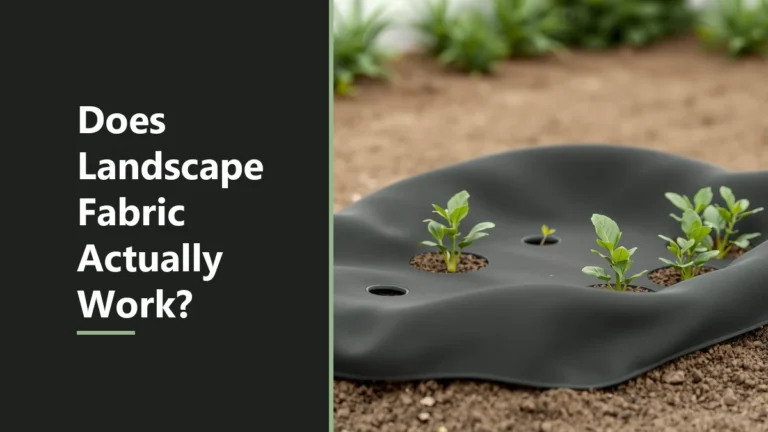
Does landscape fabric work, or does it only delay the weeds? University extension services give a split answer. The split depends on what sits on top of the fabric and how long the bed stays in place.
Landscape fabric works best under rock, gravel or mulched paths with no ornamental plants, according to UC IPM and UF/IFAS. In permanent beds topped with organic mulch, it fails over time. WSU, Clemson and UF/IFAS say weeds root in the mulch on top. UC IPM still backs fabric with shallow mulch around shrubs.
Does Landscape Fabric Work? The Honest Answer
Landscape fabric works for some jobs and fails at others, and the dividing line is what covers it. The sources agree it helps most where little organic matter builds up on top.
Linda Chalker-Scott, an extension horticulturist at Washington State University (WSU), says fabric lets water and gas through while cutting light. It also reduces weed seed germination in disturbed soil. Still, her fact sheet The Myth of Landscape Fabric ends with a clear verdict.
Her bottom line: “Geotextiles are not effective weed control solutions for permanent landscapes.”
Where it helps: the UC Statewide IPM Program (Pest Note 7441) suggests fabric under rock mulch. It keeps rock from sinking and soil from rising. A UF/IFAS Escambia County blog post by agent Beth Bolles names mulched paths and areas without ornamental plants as the best places.
Where it fails: WSU says soil or organic matter on top speeds weed colonization, so only inorganic mulch such as pebbles should cover fabric. For a rock bed or path, the landscape fabric calculator for rolls and staples sizes the order.
Where Do Extension Experts Disagree on Mulch Over Fabric?
The sources split on two points: organic mulch over fabric, and annual beds. UC IPM backs fabric under a shallow mulch layer. WSU allows only inorganic cover, and three other services report weeds growing in mulch on top.
UC IPM Pest Note 7441 (updated 2018) states that fabric under mulch controls weeds better than mulch alone. For woody shrub beds, it offers fabric with shallow mulch, or thick mulch with no fabric. It favors fabric in herbaceous perennial beds where possible.
Clemson Extension (HGIC 2337, 2023) says geotextiles do not completely control all weeds. Weeds can grow in the mulch on top, and shifting mulch exposes the fabric. Bolles at UF/IFAS writes that wind-blown seeds can raise a whole weed crop there. An Illinois Extension Good Growing blog post (Christopher Enroth, 2021) adds that decaying mulch cannot work into the soil through fabric.
Annual beds split them too. WSU says fabric works in annual beds where it can be replaced. UC IPM says not to use it where beds are replanted often. Clemson calls it not very useful there, and Illinois says repeated cuts riddle it with holes.
Can Fabric Stop Nutsedge and Other Perennial Weeds?
Fabric only partly stops nutsedge. UC IPM says a thick nonwoven fabric covered with bark or gravel suppresses nutsedge, yet yellow nutsedge can grow through most geotextiles. Bolles at UF/IFAS says purple nutsedge and torpedograss eventually grow through fabrics.
UC IPM’s Nutsedge Pest Note 7432 (updated 2024) says sharp nutsedge tips pierce black or clear plastic. Permeable polypropylene fabrics do suppress it, but complete control still means pulling emerging plants. Clemson advises controlling bermudagrass and nutsedge before a bed is built.
Chalker-Scott describes a bed where earlier owners laid fabric under 6 inches of topsoil. Bindweed and horsetail roots covered the fabric. A year after it was replaced with wood chips, the bed was nearly free of both. That is one garden, not a trial.
Woven or Nonwoven?
UC IPM says thin, lightweight or open-mesh fabrics let more weeds through than closely woven or nonwoven (spunbonded) fabrics. Thicker fabrics suppress yellow nutsedge better than thinner ones. Illinois Extension notes that stores sell woven fabric (thin plastic strips) and spun fabric (polyester fibers), and that both are somewhat porous. None of the extension sources we read assigns one type to stone and the other to planting beds.
How Long Does Fabric Keep Working, and What Happens to Roots?
The sources give different time frames. Illinois Extension says fabric suppresses weeds for only a couple of years. WSU says fabric unprotected from sunlight can degrade in as little as one year, while UC IPM calls fabrics long lasting but variable.
Clogging is the common complaint. UF/IFAS says soil and decaying mulch fill the pores, so less air and water reach roots, and some plants decline. A University of Maine Extension Ask the Expert column (Jonathan Foster, 2023) agrees. It adds that old fabric tangles in roots and comes out as a shredded mess.
Roots grow into it. UC IPM says tree and shrub roots can penetrate fabric and be damaged at removal, a concern after more than 5 years. It notes that BioBarrier, a fabric with herbicide nodules, reduces root penetration. WSU says roots colonize fabric and are damaged when it comes out, and UF/IFAS adds that roots may grow through seams.
What Are the Alternatives to Landscape Fabric?
Organic mulch alone and cardboard sheet mulching are the main alternatives the sources name. WSU prefers organic mulch for permanent landscapes because it can be reapplied without damaging plants.
For depth, UC IPM suggests 3 to 4 inches of organic mulch, and Clemson a 2- to 4-inch layer for South Carolina. Illinois says coarse arborist wood chips let water and air in, while shredded mulch can form a crust. It also suggests newspaper a couple of sheets thick, without glossy inserts.
Oregon State University Extension (EM 9559, revised July 2025) explains sheet mulching. Use plain brown corrugated cardboard, remove tape and staples, keep it from getting too thick, and soak it well. It breaks down after several months. Remove pernicious weeds such as bindweed and quackgrass first, because cardboard may not smother them. UMaine says cardboard and newspaper build soil as they biodegrade.
| Option | Weed control | Lifespan | Main caveat |
|---|---|---|---|
| Landscape fabric | Helps under rock; weeds grow in mulch on top | A couple of years (Illinois) | Pores clog; roots grow in |
| Organic mulch alone | Helps prevent weeds (Clemson) | Decomposes; reapplied (WSU) | Shredded mulch can crust (Illinois) |
| Cardboard sheet mulch | Smothers weeds under mulch (OSU) | Several months (OSU) | Limits water and air (OSU); dry cardboard sheds water (Illinois) |
How Does UC IPM Say to Install Fabric?
UC IPM’s method is to plant first, pin the fabric with long U-shaped staples, then cover it with a thin mulch layer. Here are its steps from Pest Note 7441.
- Plant, then lay fabric. Peg it down with long U-shaped staples. Cut an X over each plant and pull the plant through.
- Or lay fabric first. Cut an X, dig the hole, and keep the dug soil off the fabric, since it carries weed seed.
- Close the flaps. Fold the X back down around each stem.
- Overlap every piece. Weeds grow through any gap, so overlap the pieces and tack them down tightly.
- Cover it. Spread mulch about 1 inch deep to hide the fabric and prevent UV breakdown.
- Pull weeds early. Remove weeds growing into the fabric while they are small, before they open holes.
UC IPM gives no overlap distance and no staple spacing. It also says not to use fabric where ground covers need to root and spread.
How Much Fabric Does a Bed Really Use?
Seams can use more fabric than a flat allowance assumes, especially on narrow rolls. Two worked examples show why.
The tool’s default. The calculator’s first preset is a 300 sq ft bed with 3 x 100 ft rolls. Its 15 percent overlap allowance is a tool setting, not a source figure. Fabric needed is 300 x 1.15 = 345 sq ft, and 345 / 300 = 1.15 rolls, so you buy 2 rolls (600 sq ft). Its staple formula, also a tool setting, assumes a square bed. Edge pins are 4 x the square root of 300 = 69.3, and field pins are 300 / 9 = 33.3. The total of 102.6 rounds up to 103.
A real strip layout (our arithmetic). Take a 10 x 20 ft bed with 3 ft strips run lengthwise and the tool’s 6 in seam overlap. Each strip after the first adds 2.5 ft, so 4 strips cover 10.5 ft. That is 80 linear ft, or 240 sq ft: 20 percent over the 200 sq ft bed. The tool’s 15 percent gives 230 sq ft. Both fit on one roll, but seams alone beat the allowance. Pinning every foot of edges and seams takes about 117 pins, versus 79 from the tool formula.
Enter your bed area and roll size in the GeniesMag Landscape Fabric Calculator. Add extra for seams on narrow rolls.
FAQs About Landscape Fabric
Does landscape fabric work in annual flower beds?
Sources disagree. WSU says fabric works in annual beds where it can be replaced. UC IPM says not to use it where beds are replanted often, and Clemson calls it not very useful there.
Why do weeds grow on top of landscape fabric?
Seeds land in the mulch or soil on top and sprout there. WSU, Clemson and UF/IFAS all describe this, and WSU says roots of those weeds can eventually grow through the fabric.
Will landscape fabric stop nutsedge?
Only partly. UC IPM says thick nonwoven fabric under bark or gravel suppresses nutsedge, but you still pull new shoots. UF/IFAS says purple nutsedge eventually grows through fabrics.
Is cardboard a better weed barrier than fabric?
Cardboard breaks down after several months, says Oregon State, and UMaine says it builds soil. While intact, it limits water and air. Use plain brown cardboard, remove tape and soak it first.
How long does landscape fabric keep weeds down?
Estimates vary. Illinois Extension says only a couple of years. WSU says fabric left in sunlight can degrade in as little as one year. UC IPM calls fabrics long lasting but variable in effectiveness.
Should I pull out old landscape fabric around shrubs?
Weigh the root risk. UC IPM says removal can damage roots that grew into fabric, a concern after 5 years. WSU says roots that colonize fabric are damaged when it comes out.
Do I need fabric under gravel or rock?
UC IPM suggests considering it, because fabric keeps rock from sinking and soil from rising. WSU accepts only inorganic cover such as pebbles. Illinois Extension says rock mulch adds no value for plants.
Sources and Further Reading
References Used in This Article
- Washington State University, Linda Chalker-Scott, The Myth of Landscape Fabric (extension fact sheet, PDF), accessed 2026-11-15.
- UC Statewide IPM Program, Pest Notes: Weed Management in Landscapes, Publication 7441, accessed 2026-11-15.
- Clemson Cooperative Extension, HGIC 2337, Weed Control in Landscapes: Non-Chemical Measures, accessed 2026-11-15.
- Oregon State University Extension, EM 9559, Sheet Mulching and Lasagna Composting with Cardboard, accessed 2026-11-15.
- UF/IFAS Extension Escambia County, Consider Landscape Fabric Carefully (county extension blog post), accessed 2026-11-15.
This guide summarizes university extension publications; it is not a site plan. Your local extension office and supplier decide what fits your yard. Reviewed for accuracy by Prof. Dr. Khalil Mudassar, PhD. Last updated 2026-11-15.

Shakeel Muzaffar is the Founder and Editor-in-Chief, with over 15 years of experience in digital publishing and online tool development. He oversees editorial quality and formula verification to ensure accurate, practical, and easy-to-use calculators.