
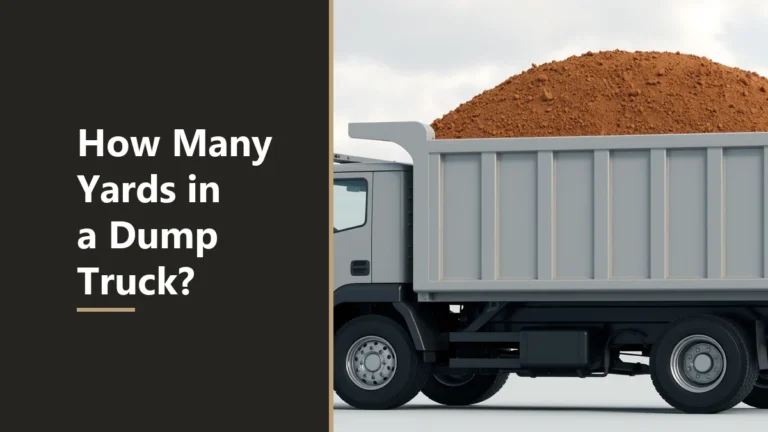
Can a dump truck with room for 12 cubic yards legally haul 12 yards of wet sand? Often it cannot. The body sets one limit, but federal and state weight rules set another, and the lower one wins.
How many yards in a dump truck depends on two limits: body volume and the legal weight on its axles. Whichever runs out first sets the load. In our example, a three-axle truck with an assumed 26,000 lb payload hits its weight limit at 9 to 10 loose yards of dry sand.
Volume or Weight: What Decides How Many Yards in a Dump Truck?
A dump truck carries as many loose cubic yards as its body holds or its legal weight allows, whichever limit it reaches first. Light material fills the body first. Heavy material reaches the weight limit with room to spare.
The U.S. Army earthmoving manual, FM 5-434 (2000), makes the same point. It says hauling capacity can be stated by weight in tons, by struck body volume or by heaped body volume. It tells crews not to load more volume than the truck’s weight capacity allows. The Army rates its own dump trucks by weight, as 5-ton and 20-ton trucks.
You can watch both limits at work in our dump truck load calculator. Its first preset hauls 100 loose cubic yards of fill dirt in a tandem truck. The tool’s settings are a 12 cubic yard body, a 15-ton payload and fill at 2,500 lb per cubic yard. These are typical figures from commercial guides, not legal limits.
- By volume. 100 / 12 = 8.33, which rounds up to 9 loads.
- By weight. 100 x 2,500 / 2,000 = 125 tons, and 125 / 15 = 8.33, which also rounds up to 9 loads.
The two limits tie at 9 loads in this case. Swap in gravel or a different truck, and one limit pulls ahead.
What Do Federal Rules Allow on the Interstate?
On the Interstate, federal rules allow 20,000 lb on any one axle, 34,000 lb on a tandem group and 80,000 lb gross. These limits come from 23 CFR 658.17 and cover the Interstate System and reasonable access to it.
The FHWA guide Bridge Formula Weights (FHWA-HOP-19-028, 2019) puts the gross cap plainly: “Gross vehicle weight is limited to 80,000 pounds (23 U.S.C. 127).” The regulation adds a catch. The gross drops wherever the bridge formula dictates a lower weight.
The sources frame the 80,000 lb figure in different ways. The statute, 23 U.S.C. 127, says states must allow at least 80,000 lb for vehicle combinations of five axles or more. MnDOT lists 80,000 lb for five or more properly spaced axles. A single-unit dump truck with three or four axles normally sits well below that.
FHWA treats axles more than 40 and up to 96 inches apart as a tandem. The limits include all enforcement tolerances, apart from a portable scale allowance of no more than 5 percent. The FHWA size and weight overview (2003) adds that off the Interstate, states may set their own weight standards.
How Does the Bridge Formula Shrink a Dump Truck’s Payload?
The bridge formula limits the weight on a group of axles by how many axles there are and how far apart they sit. FHWA says Congress enacted it in 1975 to limit a vehicle’s weight-to-length ratio on bridges. Here is the formula from 23 U.S.C. 127.
W = 500 x (L x N / (N – 1) + 12 x N + 36).
W is the gross weight in pounds on the group, to the nearest 500 lb. L is the distance in feet between the outer axles, and N is the number of axles. Take a three-axle dump truck, with one front axle and a rear tandem as an example layout. The spacings below are assumptions, and the math is ours.
- L = 20 ft: 500 x (30 + 36 + 36) = 51,000 lb. The FHWA and Caltrans tables print the same value.
- L = 24 ft: 500 x (36 + 36 + 36) = 54,000 lb. That equals 20,000 single plus 34,000 tandem, so from about 24 ft the axle limits set the gross.
Payload is the legal gross minus the empty truck. We assume an empty weight of 25,000 lb, since none of our sources gives one. That leaves 26,000 lb (13.0 tons) at 20 ft and 29,000 lb (14.5 tons) at 24 ft. The tool’s 15-ton tandem setting would need an empty truck of 24,000 lb or less at a 54,000 lb gross.
How Do Minnesota and California Set Their Own Limits?
Off the Interstate, states may set their own weight rules, and the two states checked here differ in useful ways. Minnesota ties its limits to the road surface, while California caps longer axle groups.
MnDOT’s 2022 truck book makes all paved Minnesota routes 10-ton routes unless posted: 20,000 lb per single axle, 34,000 lb per tandem group. Unpaved routes are 9-ton routes unless posted, with 18,000 lb per single axle. Seasonal load restrictions go further. Between dates the Commissioner sets, a single axle may carry no more than five tons on unpaved roads or ten tons on paved ones.
Caltrans summarizes the California Vehicle Code this way. A single axle may carry 20,000 lb, and a group under 8 ft 6 in between outer axles 34,000 lb. Its table caps three axles at 60,000 lb from 32 ft, while the federal formula keeps climbing to 66,000 lb at 40 ft (our arithmetic). Counties and cities may permit heavier loads on their own roads, though not on state highways.
Even short groups differ. FHWA and Caltrans give 42,500 lb for three axles 9 ft apart; Minnesota’s 9-ton posting allows 43,000 lb.
| Rule set | Single axle | Tandem group | Gross | Where it applies |
|---|---|---|---|---|
| Federal, 23 CFR 658.17 | 20,000 | 34,000 | 80,000, or less under the bridge formula | Interstate and reasonable access to it |
| Minnesota, MnDOT 2022 | 20,000 on 10-ton routes; 18,000 on 9-ton routes | 34,000 | 80,000 for five or more properly spaced axles | Paved roads default to 10-ton, unpaved to 9-ton; seasonal limits apply |
| California, Caltrans summary of the Vehicle Code | 20,000 | 34,000 (outer axles under 8 ft 6 in apart) | 80,000 for a combination; three axles capped at 60,000 | Counties and cities may permit more on their own roads |
How Much Does a Loose Cubic Yard of Dirt, Sand or Gravel Weigh?
FM 5-434 puts loose material weights anywhere from 1,700 lb per cubic yard for dry clay to 3,500 lb for trap rock. Water moves the numbers a lot. Loose loam or silt weighs 1,900 to 2,200 lb per cubic yard dry, but 2,800 to 3,200 lb wet.
The Army calls its Table 1-2 figures averages for common materials. Weights vary with grain size, moisture and compaction, so the manual advises weighing a sample for an exact figure.
A second table, hosted by MoDOT and apparently from Michigan’s Local Technical Assistance Program (LTAP), lists loose sand at 2,630 to 2,960 lb. That is close to the Army’s dry sand range, with no wet or dry split. Its granite or limestone, 2,410 to 2,590 lb, is lighter than the Army’s dry gravel, but these are different materials. Neither source lists fill dirt or topsoil. The tool’s clay setting of 2,600 lb sits inside FM 5-434’s wet clay range.
How Many Yards Fit by Weight in a 12-Yard Body?
With a 26,000 lb payload, sand, gravel and wet soil hit the weight limit at about 8 to 10 yards. Dry loam and dry clay can nearly or fully fill a 12-yard body. This is our arithmetic, with the empty weight and the 12-yard body both assumed.
Divide the payload by FM 5-434’s loose weights. Dry sand fits at 26,000 / 2,900 = 9.0 yards to 26,000 / 2,600 = 10.0 yards. Dry loam or silt allows 11.8 to 13.7 yards, so at its heavy end the weight limit arrives just short of 12. Dry clay allows 13.0 to 15.3 yards, so the body fills first. At the 29,000 lb payload, dry sand rises to 10.0 to 11.2 yards.
Body volume has fine print too. FM 5-434 defines struck as level with the top of the container and heaped as piled above its sides. Its glossary names dump-truck bodies among those containers. But the only heap shape it gives, a 1:1 slope, is for scraper bowls, so it is not a dump truck rating rule. Swell is separate: FM 5-434 says 1 bank cubic yard of dry clay swells 40 percent to 1.4 loose yards. Haul counts use the loose figure.
Enter your loose volume, truck type and material in the Dump Truck Calculator to compare loads by volume and by weight. Then confirm the real legal payload with your hauler, because axle spacing, empty weight and the road all change it.
FAQs About Dump Truck Capacity
Is a dump truck allowed to weigh 80,000 pounds?
Not automatically. The 80,000 lb federal cap applies on the Interstate, and the bridge formula lowers it for short axle groups. By our arithmetic, three axles spread 20 feet apart are held to 51,000 lb.
Does wet dirt weigh more per yard than dry dirt?
Yes. FM 5-434 lists loose loam or silt at 1,900 to 2,200 lb per cubic yard dry and 2,800 to 3,200 lb wet. Wet soil can cut the yards a truck may legally carry.
Do state weight limits apply on local roads?
Yes. Federal limits cover the Interstate, and states set their own limits elsewhere. Minnesota’s unpaved roads default to 18,000 lb per single axle, and seasonal restrictions can drop that to five tons.
What is the difference between struck and heaped capacity?
Struck means level with the top of the container, and heaped means piled above its sides. FM 5-434 defines both, but its only heap shape, a 1:1 slope, is for scraper bowls.
Why does gravel reach the weight limit before the body is full?
Gravel is dense. FM 5-434 lists dry gravel at 2,700 to 3,000 lb per loose cubic yard. An assumed 26,000 lb payload runs out at about 8.7 to 9.6 yards.
How many tons does a 12-yard load of dry sand weigh?
About 15.6 to 17.4 tons. Using FM 5-434’s dry sand range of 2,600 to 2,900 lb per loose cubic yard, 12 yards weigh 31,200 to 34,800 lb (our arithmetic).
Can a hauler get a permit to carry a heavier load of gravel?
Ask your state. Federal rules allow special permits for nondivisible loads; ask your state DOT whether a load like gravel qualifies. California counties and cities may permit heavier loads on their own roads.
Sources and Further Reading
References Used in This Article
- eCFR, 23 CFR 658.17, Weight (federal rule), accessed 2026-11-15.
- FHWA, Bridge Formula Weights, FHWA-HOP-19-028 (August 2019), accessed 2026-11-15.
- MnDOT, Minnesota Trucking Regulations, Section 04: Weight Limitations (2022), accessed 2026-11-15.
- Caltrans, Weight Limitation (California Vehicle Code summary), accessed 2026-11-15.
- U.S. Army, FM 5-434 Earthmoving Operations (June 2000), mirror copy at vulcanhammer.net, accessed 2026-11-15.
Weight limits here summarize federal and state sources and can change. Your state DOT, local road postings, any permits and your hauler decide what a truck may legally carry. Reviewed for accuracy by Prof. Dr. Khalil Mudassar, PhD. Last updated 2026-11-15.

Shakeel Muzaffar is the Founder and Editor-in-Chief, with over 15 years of experience in digital publishing and online tool development. He oversees editorial quality and formula verification to ensure accurate, practical, and easy-to-use calculators.