
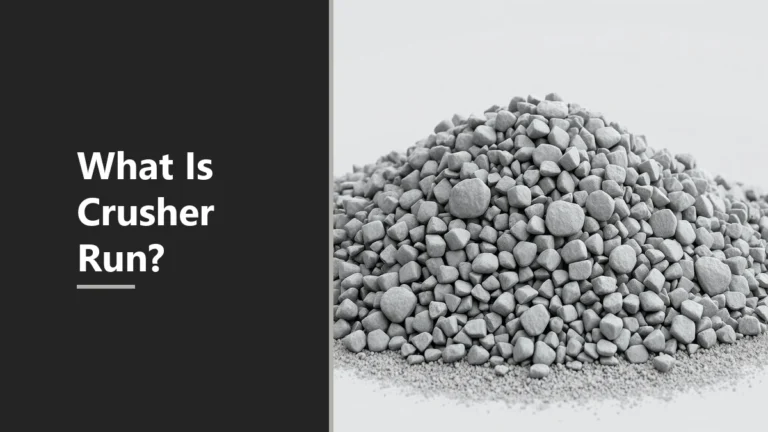
Why can two piles sold as crusher run look so different? The name comes from stone yards, not highway specs. The real limits on stone size, dust and clay sit in state specs, and each state writes them differently.
Crusher run is a yard trade name for a crushed stone base that keeps its fine dust instead of washing it out. None of four state DOT specs we read uses the term. The closest spec materials are Virginia 21A or 21B, PennDOT 2A, NCDOT ABC and NYSDOT Type 2, which cap fines at 7 to 12 percent.
Is Crusher Run an Official Spec Name?
No. Crusher run is a trade name, and none of the four state highway specs we read uses it. Searches of the Virginia, Pennsylvania, North Carolina and New York specs for crusher run, crush and run and quarry process found zero hits.
Instead, each state names its own dense-graded aggregate: a stone mix that runs from coarse pieces down to dust. Virginia DOT’s 2020 Road and Bridge Specifications list Sizes 21A and 21B in Section 208. Section 208.01 states the purpose: “These specifications cover material used to form a foundation for base or surface pavement.”
PennDOT Publication 408/2020 uses No. 2A. NCDOT’s January 2024 Standard Specifications use ABC, short for aggregate base course. NYSDOT’s September 2026 specifications list subbase Type 2, made by crushing or blasting ledge rock.
Treat these as the state materials closest to what yards sell as crusher run, not official equivalents. Only a yard’s current test report shows which spec, if any, a pile meets. For tonnage, use the crusher run tonnage calculator.
How Do Virginia, Pennsylvania, North Carolina and New York Grade It?
The four specs share one idea, crushed stone with fines, but differ on top size, sieves, fines and plasticity. North Carolina’s ABC tops out at 1 1/2 inches. Virginia 21A and 21B, PennDOT 2A and NYSDOT Type 2 all pass 100 percent through a 2 inch sieve.
The sieve sets differ too, so a true sieve-by-sieve match is possible only at top size, No. 40 and No. 200.
| Material (agency, edition) | Top size | Key sieves | No. 200 fines | Plasticity index cap |
|---|---|---|---|---|
| Size 21A (VDOT 2020) | 2 in | 1 in 94-100; 3/8 in 63-72; No. 10 32-41; No. 40 14-24 | 6-12 | 6.0 as subbase or Type II base; 3.0 as Type I base (single test) |
| Size 21B (VDOT 2020) | 2 in | 1 in 85-95; 3/8 in 50-69; No. 10 20-36; No. 40 9-19 | 4-7 | 6.0 as Type II base; 3.0 as Type I base (single test) |
| No. 2A (PennDOT Pub 408/2020) | 2 in | 3/4 in 52-100; 3/8 in 36-70; No. 4 24-50; No. 16 10-30 | 10 max (Section 350 subbase) | None found in Section 703.2 |
| ABC (NCDOT 2024) | 1 1/2 in | 1 in 75-97; 1/2 in 55-80; No. 4 35-55; No. 10 25-45; No. 40 14-30 | 4-12 | 4 (LL 30 max); over 6 rejected |
| Subbase Type 2 (NYSDOT 2026) | 2 in | 1/4 in 25-60; No. 40 5-40 | 0-10 | 5.0 or less |
Virginia’s numbers are design ranges for a producer’s job-mix formula. PennDOT’s figures come from the Initial Edition of Publication 408/2020; we did not check its later Changes or NCDOT’s 2024 revision memos.
Why Do Fines and Plasticity Limits Matter?
Fines are the dust that passes the No. 200 sieve, and plasticity limits keep that dust from acting like clay. Each state sets its own floor and ceiling.
- Virginia (VDOT 2020): 21A carries 6 to 12 percent fines and 21B carries 4 to 7 percent. A single test caps the liquid limit at 25.0.
- North Carolina (NCDOT 2024): ABC allows 4 to 12 percent. Its minus No. 40 portion may not exceed a liquid limit of 30 or a plasticity index of 4. A PI above 4 and up to 6 triggers soil mortar limits; above 6, the stone is rejected.
- Pennsylvania (PennDOT): 2A used as Section 350 subbase allows at most 10 percent, with no minimum stated.
- New York (NYSDOT 2026): Type 2 allows 0 to 10 percent, with a plasticity index of 5.0 or less.
One field test can land outside a design band and still pass. Say a 21A job-mix formula targets 9 percent fines (our example, not a VDOT figure). VDOT Table II-10 allows plus or minus 4.0 points on one test, so 5 to 13 percent passes. The mean of four tests must fall within plus or minus 2.0, or 7 to 11 percent.
How Is Crusher Run Different From Washed No. 57 Stone?
No. 57 stone is an open-graded, clean stone with almost no dust, while crusher run style bases keep their fines on purpose. The two serve different jobs.
Virginia, Pennsylvania and North Carolina agree on the No. 57 grading. All of it passes 1 1/2 inches, and no more than 10 percent passes the No. 4 sieve. Fines limits differ by state and use:
- VDOT 2020: no more than 1.00 percent passing the No. 200 sieve by washing, or 1.50 percent when it is dust of fracture.
- NCDOT 2024: 1.0 percent in the quarry stockpile; 1.5 or 2.0 percent at the job site, for concrete and asphalt uses.
- PennDOT Table D: 2 percent maximum for all other uses.
In Virginia, the leanest 21A design carries at least 6 times the fines limit of No. 57 (6 divided by 1.00). At 12 percent, it is 12 times. NCDOT’s own remarks list No. 57 for shoulder drains and sediment control stone, and ABC for aggregate base course. No source we read gives drainage rates for either stone, so we do not quote any.
How Do State Specs Compact Dense-Graded Base?
Virginia and North Carolina both require 100 percent of a lab maximum density in the common case. That is stricter than the 95 percent figure some guides repeat.
VDOT 2020 Section 309.05 ties the target to the stone retained on the No. 4 sieve. With 0 to 50 percent retained, the target is 100 percent of theoretical maximum density (VTM-1). It drops to 95 percent for 51 to 60 percent retained and 90 percent for 61 to 70. Compaction happens at optimum moisture, plus or minus 2 points. No more than one sample in five may fall short, and that one by no more than 2 percent.
NCDOT 2024 Section 520-9 requires each layer to reach at least 100 percent of AASHTO T 180, the modified Proctor test, under the ring method. PennDOT 350.3(e) asks for a condition of non-movement. We did not read NYSDOT’s compaction section.
Layer rules differ as well. VDOT caps a compacted layer at 6 inches, or up to 10 inches with approved equipment. NCDOT splits layers only above 10 inches total, and PennDOT keeps 2A layers between 3 and 8 inches. These are highway rules; your inspector or engineer sets what applies to your job.
How Many Tons Does a 500 Square Foot Area Need?
A 500 square foot area at 4 inches finished depth works out to about 11.11 tons to order, using the calculator’s default settings. Here is the arithmetic, checked by hand:
- Volume. 500 sq ft x 4 in = 2,000; 2,000 / 324 = 6.17 cubic yards.
- Base weight. 6.17 cu yd x 1.5 tons per cu yd = 9.26 tons.
- Allowance. 9.26 x 1.20 (a 20 percent allowance) = 11.11 tons.
- Coverage. 324 / (1.5 x 4) = 54 square feet per ton at 4 inches.
The 1.5 tons per cubic yard and the 20 percent allowance are tool settings, not spec figures. None of the four specs we read gives a unit weight for 21A, 2A, ABC or Type 2. Ask your yard what its product weighs per cubic yard, and enter that figure as an override. VDOT 309.06 itself pays for base by compacted cubic yards on the road or by tons.
What Should You Ask the Stone Yard Before Ordering?
Ask which state spec the product meets, and ask for a recent test report that proves it.
- Which spec? Ask whether it meets VDOT 21A or 21B, PennDOT 2A, NCDOT ABC or NYSDOT Type 2, or another local standard.
- Fines and PI. Ask for the percent passing No. 200 and the plasticity index from the latest test.
- Stone source. VDOT Type I base is crushed stone, slag or crushed gravel. NCDOT allows uncrushed gravel in ABC. NYSDOT Type 2 is crushed ledge rock.
- Recycled content. PennDOT says recycled concrete used as 2A shall not be used in subbase. Ask whether the pile contains any.
Local rules, permits, inspectors and your engineer or supplier make the final call for your site.
Enter your area, depth and your yard’s weight per yard in the GeniesMag Crusher Run Calculator to get tons, cubic yards and coverage.
FAQs About Crusher Run
Is crusher run the same as 21A?
Not officially. Virginia DOT’s 2020 spec never uses the name crusher run. Size 21A is a Virginia dense-graded aggregate with 6 to 12 percent fines. Ask your yard whether its product meets 21A.
Is crusher run an official DOT term?
No. The Virginia, Pennsylvania, North Carolina and New York specs we read never use crusher run, crush and run or quarry process. Each state uses its own name, such as 21A, 2A, ABC or Type 2.
Does crusher run drain as well as clean stone?
Likely not. Dense-graded bases allow up to 7 to 12 percent fines, while washed No. 57 stone is held near 1 to 2 percent. No source we read gives drainage rates for either.
What does the plasticity index limit mean for base stone?
It caps how clay-like the fines can act. NCDOT 2024 caps ABC at a PI of 4, NYSDOT 2026 caps Type 2 at 5.0, and VDOT 2020 caps 21A at 6.0 as subbase.
How much area does a ton of crusher run cover?
About 54 square feet at 4 inches, using the calculator’s 1.5 tons per cubic yard. That weight is a tool setting, not a spec figure, so ask your supplier for the real weight.
Can I use No. 57 stone instead of crusher run?
They are built for different jobs. No. 57 is open-graded, with no more than 10 percent passing the No. 4 sieve. Dense-graded base keeps its fines. Your engineer or supplier should match the stone to the job.
How tightly should dense-graded base be compacted?
VDOT 2020 asks for 100 percent of maximum density when 50 percent or less is retained on the No. 4 sieve. NCDOT 2024 asks for at least 100 percent of AASHTO T 180. Your inspector decides locally.
Sources and Further Reading
References Used in This Article
- Virginia DOT, Road and Bridge Specifications, 2020 (Sections 203, 208 and 309), accessed 2026-11-15.
- Pennsylvania DOT, Publication 408/2020 Specifications, Initial Edition (Sections 350 and 703.2), accessed 2026-11-15.
- North Carolina DOT, Standard Specifications for Roads and Structures, January 2024 (Sections 520, 1005 and 1010), accessed 2026-11-15.
- New York State DOT, Standard Specifications (US Customary), Volume 4, September 1, 2026 (Section 733-04, Subbase Course), accessed 2026-11-15.
These figures come from four state highway specs, not from any yard’s product. Local rules and supplier test reports decide what applies. Reviewed for accuracy by Prof. Dr. Khalil Mudassar, PhD. Last updated 2026-11-15.

Shakeel Muzaffar is the Founder and Editor-in-Chief, with over 15 years of experience in digital publishing and online tool development. He oversees editorial quality and formula verification to ensure accurate, practical, and easy-to-use calculators.